Guide
What a Crypto Index Is, and What It Actually Measures
Guides · Sep 6, 2026
GuidesIndices
A crypto index tracks a basket of coins as one number. How the value is calculated, what the divisor does, and how to tell a real benchmark from a running total.
A crypto index tracks a basket of cryptocurrencies as a single number. It takes the combined market value of the selected assets, divides that by a maintenance figure called the divisor, and reports the result against a starting value. Instead of checking forty tickers to see how the market did, you check one line that already accounts for the size of each asset.
That is the whole idea. Everything else is bookkeeping: which coins are in, how much each counts, and how often the list is revised. The bookkeeping is where two indices with similar names stop being comparable, so it is worth understanding before you read any index value at all.
How is a crypto index calculated?
The formula is simple:
index value = combined market value of the basket ÷ divisorSay a basket was worth $400 billion the day the index launched, and the publisher set that day to read 1,000. If the basket is worth $520 billion now, the index reads 1,300.
The level itself is arbitrary. The change is the information. This is why comparing the level of two indices is meaningless: one reading 1,300 and another reading 4,200 are not saying anything about which market is bigger. They started counting on different days from different bases.
What you compare is performance over the same window. Same start date, same end date, same currency.
What is the divisor and why does it exist?
If a coin is added to the index, the basket suddenly holds more value than it did a second earlier. Without a correction, the index would jump on an event that had nothing to do with the market moving. Same problem in reverse on a removal.
So the publisher adjusts the divisor whenever composition changes, so the index reads exactly the same on both sides of the change. Price moves alter the index. Housekeeping does not.
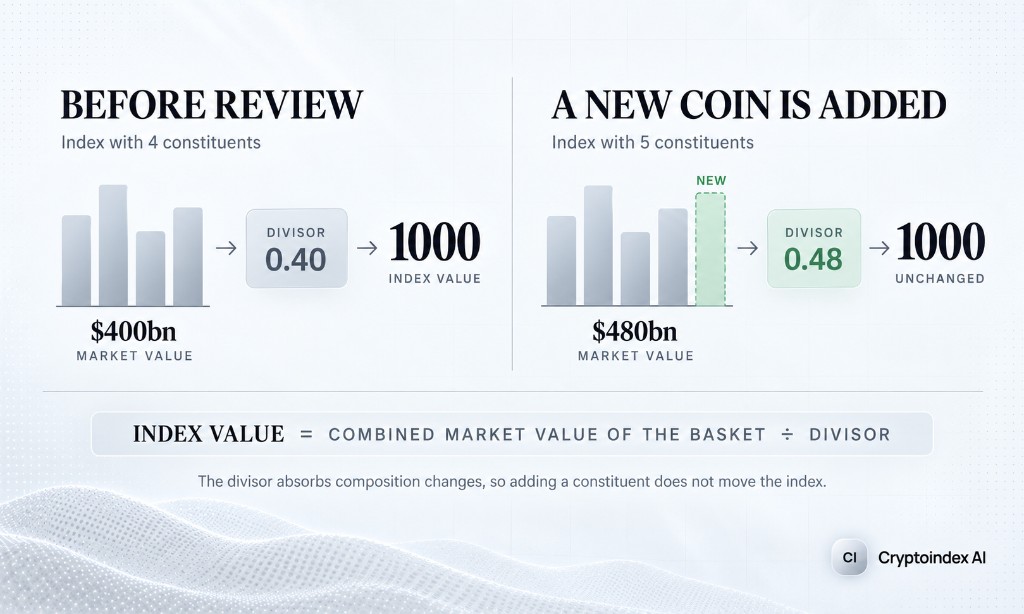
Before review
4 constituents
$400bn market value
Divisor 0.40
1,000 index value
A new coin is added
5 constituents
$480bn market value
Divisor 0.48
1,000 unchanged
Index value = combined market value of the basket ÷ divisor
The divisor absorbs composition changes, so adding a constituent does not move the index.
| Event | Basket value | Index value |
|---|---|---|
| A constituent rallies 20% | Rises | Rises |
| A new coin is added at review | Rises | Unchanged, divisor adjusts |
| A coin is removed | Falls | Unchanged, divisor adjusts |
| Supply changes on a constituent | Shifts | Unchanged, divisor adjusts |
This mechanism is standard in equity indices and it is old. If a published series does not do it, it is not really an index. It is a running total of whatever the author decided to include this week.
What are the three decisions behind every index?
Every publisher answers the same three questions. Different answers give you very different products with very similar names.
Selection. Which assets qualify. Usually a top-N by market capitalisation, filtered by exchange listings, liquidity thresholds and custody availability. Some methodologies exclude stablecoins, wrapped assets and memecoins by rule. Others do not.
Weighting. How much each asset counts. Market-cap weighting gives the largest assets the largest share. Equal weighting gives every asset the same share. Capped weighting lets the leader run up to a ceiling, commonly 20% to 30%, and redistributes the rest.
Maintenance. How often the basket is reviewed and what happens between reviews. Quarterly reconstitution is the common convention, with weights drifting on price in between.
Two indices holding the same ten coins can post noticeably different returns purely because of the second and third decisions.
Free float or circulating supply?
Market capitalisation is price times supply. The argument is over which supply.
Circulating supply counts every unit that exists and is not burned. Free float counts only units actually available to trade, stripping out locked tokens, foundation treasuries and unvested team allocations.
For bitcoin the two are close. For a young token with a third of supply still vesting they are not, and a market-cap-weighted index using circulating supply will assign that token a weight no investor could replicate at those prices. Research groups such as Coin Metrics publish free-float adjusted figures for exactly this reason.
When a coin sits much higher in one index than another, check the supply definition first.
Price return or total return?
A price-return index tracks price only. A total-return index also credits staking rewards earned by the underlying assets.
For a basket heavy in proof-of-stake assets this is not a rounding error over a year. If you are comparing an index against a fund that stakes its holdings, make sure both sides are measured the same way. Most published headline crypto indices are price return unless the methodology says otherwise.
What is a crypto index good for?
Answering "how did the market do" honestly. Bitcoin's move is not the market's move. A broad index tells you whether strength was general or concentrated in two names.
Benchmarking your own results. If your portfolio is up 12% this quarter and a broad index is up 30%, you have learned something specific that a raw profit number was hiding.
Reading rotation. Comparing a broad index against Bitcoin dominance and the Altcoin Season Index shows where capital is actually going.
What a crypto index is not
It is not a forecast. It is not risk adjusted. And it is not automatically diversified because it holds many assets. A ten-asset basket where two names carry 90% of the weight behaves like a two-asset portfolio, whatever the fact sheet says.
Concentration is measurable in ten seconds. Add the top two weights. Above 80% and you own a two-asset portfolio. We walk through that in Your Ten-Asset Crypto Index Is Mostly Two Assets.
Frequently asked questions
Is a crypto index the same as a crypto index fund? No. The index is the rule and the number. The fund is a product that holds the assets in those proportions and charges a fee. An index can exist with no fund attached, and most do.
Why do two sites show different values for the same market? Different constituent lists, different supply definitions, different exchange price sources and different rebalancing dates. All four are legitimate design choices and all four move the number.
How many coins should a crypto index hold? It depends on the question. Ten large caps describe the institutional core of the market. A hundred names describe breadth, including a tail that barely affects a cap-weighted result but says a lot about participation.
Can I buy a crypto index directly? Not the index itself. You buy a product that tracks it, or you replicate the basket yourself. See how to invest in a crypto index.
Who publishes crypto indices? Specialist administrators and exchanges. CoinDesk Indices and Nasdaq run well-known families, alongside asset managers publishing their own methodologies. Cryptoindex.ai publishes its own series under rules set out on the methodology page.