Guide
How to Invest in a Crypto Index: 4 Ways Compared
Guides · Sep 3, 2026
GuidesInvesting
You cannot buy an index, only a product that tracks it. ETPs, private funds, DIY baskets and the top-two approach compared on cost, custody and access.
You cannot buy an index. An index is a rule and a number. What you can buy is a product that tracks it, or you can build the basket yourself. There are four practical routes: exchange-traded products, private index funds, a self-built basket, and simply holding the top two assets in index proportions.
They differ far more in custody, access and tax treatment than in performance. Here is what each one costs and where each one breaks.
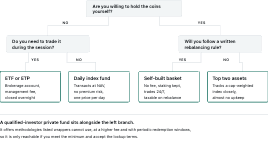
Which route fits which investor?
Are you willing to hold the coins yourself?
No
Do you need to trade it during the session?
Yes
ETF or ETP
- Exchange liquidity
- Management fee
- Counterparty risk
No
Private fund
- Secondary market
- No wallet work
- Exit can take a day
Yes
Will you follow a written rebalancing rule?
Yes
Self-built basket
- No management fee
- Your custody, your time
- Execution and tax drag
No
Top two assets
- Easy to keep
- Most of the cap-weight result
- Little breadth
A qualified-investor private fund sits on the left branch. A self-built basket only works if the rebalance rule is written before the first trade.
| ETP or ETF | Private fund | DIY basket | Top two | |
|---|---|---|---|---|
| Account needed | Brokerage | Qualified investor | Exchange or wallet | Exchange or wallet |
| Ongoing fee | Yes | Yes, higher | None | None |
| Trades 24/7 | No | No | Yes | Yes |
| You hold the keys | No | No | Optional | Optional |
| Staking yield | Usually no | Sometimes | Yes | Yes |
| Rebalancing work | None | None | Yours | Minimal |
| Taxable event on rebalance | No | No | Yes | Rare |
Route 1: exchange-traded products
In the United States these are spot crypto ETFs and, increasingly, multi-asset index products. In Europe they are ETPs and ETNs, usually physically backed and listed on regulated exchanges.
What you get. A ticker in an ordinary brokerage account. No wallets, no seed phrase, no exchange account. It settles like a stock and fits inside retirement accounts where those exist.
What it costs. A management fee charged continuously against assets, plus the spread when you trade, plus brokerage commission.
Where it breaks. Trading hours. The underlying market runs all night and all weekend; the listed product does not, so gaps open at the open. And regulated wrappers generally cannot hold one asset at 65%, so the index behind them is usually capped. That means it is not tracking the market as it actually is.
See the product comparison in best crypto index funds and ETFs.
Route 2: private and offshore index funds
Structures aimed at accredited or professional investors, holding a defined basket and rebalancing to a published methodology.
What you get. Access to methodologies listed wrappers cannot use, including broader universes and strategies that stake the underlying assets.
What it costs. Management fee, sometimes a performance fee, and a minimum investment that makes this route irrelevant for most people.
Where it breaks. Liquidity. Subscriptions and redemptions may run on a periodic schedule rather than continuously. Read the redemption terms before you read the performance chart.
Route 3: build the basket yourself
Buy the constituents in the published proportions and rebalance on a schedule.
What you get. No management fee, full control of the asset list, custody in your own hands if you want it, and the ability to stake what is stakeable and keep the yield. A price-return index does not credit that yield at all, so a well-run DIY basket can beat the index it copies.
What it costs. Trading fees on every rebalance, spreads on the smaller names, your own time, and in taxable jurisdictions a realised gain on every trim.
Where it breaks. Discipline and the tail. Rebalancing feels wrong every time, because it means selling your winner. And replicating a fifty-name index at retail size means holding positions worth very little that still cost fees and attention. Most self-built baskets end up holding the top ten, which is usually the right call.
A workable rule: rebalance quarterly, or when any weight drifts more than 5 percentage points from target, whichever comes first. Write the rule down before you start, because you will not want to follow it on the day.
Route 4: hold the top two and stop pretending
A cap-weighted large-cap crypto index is mostly bitcoin and ether. Holding those two in something near index proportions gets you most of the way to index performance with almost none of the complexity.
This is not a joke, it is what the concentration math implies. If the top two weights add to 85%, the other eight names move your annual result by a few percent either way, and you are paying spreads and attention for that.
The honest reason to hold the tail is that you want exposure to breadth. If that is what you want, an equal-weighted approach is the tool, not a cap-weighted basket with a long list of names that barely register.
We walk through the weights in Your Ten-Asset Crypto Index Is Mostly Two Assets.
What should you check before buying anything?
Which index does it track, and is the methodology public? If the rules are not published, you are buying a discretionary portfolio with an index-sounding name.
What are the top two weights? This is the actual portfolio. Check it before you look at the fee.
Is the index capped, and is the cap enforced continuously or only at review? A cap applied quarterly is a starting condition, not a constraint. The product can sit well above its stated ceiling for weeks.
Price return or total return? For a basket with meaningful proof-of-stake exposure this is a real annual difference.
What is the total cost? Management fee plus spread plus any premium or discount to net asset value. Some products trade persistently away from the value of what they hold.
A fee difference of 0.20% a year is real but small. A weighting difference that moves bitcoin exposure from 30% to 65% is enormous. People routinely spend hours on the first and no time on the second.
Frequently asked questions
Can I buy a crypto index directly? No. An index is a calculation, not an asset. You buy a fund or exchange-traded product that tracks it, or you replicate the basket yourself by holding the constituents in the published weights.
Is a crypto index fund safer than picking coins? It reduces single-name risk and does very little for market risk. Crypto assets are highly correlated in drawdowns, so a broad index falling 60% in a bear market is normal behaviour, not a product failure.
How often should I rebalance a DIY crypto basket? Quarterly is a reasonable default. More frequent rebalancing raises trading costs and taxable events without reliably improving results. Threshold rebalancing, acting when a weight drifts beyond a set band, is the common alternative.
Do I need to hold all fifty coins to track a broad index? No. In a cap-weighted index the top ten names typically explain the vast majority of the movement. Holding the tail adds cost and complexity for very little tracking improvement.
What if the index I want has no fund attached? That is common, and fine. Use it as a benchmark and build exposure separately through the routes above. Track the live series on the indices page and read the rules on the methodology page.