Index Methodology · Oct 5, 2026
What Is a Crypto Index, Really?
IndicesMethodologyBenchmarks
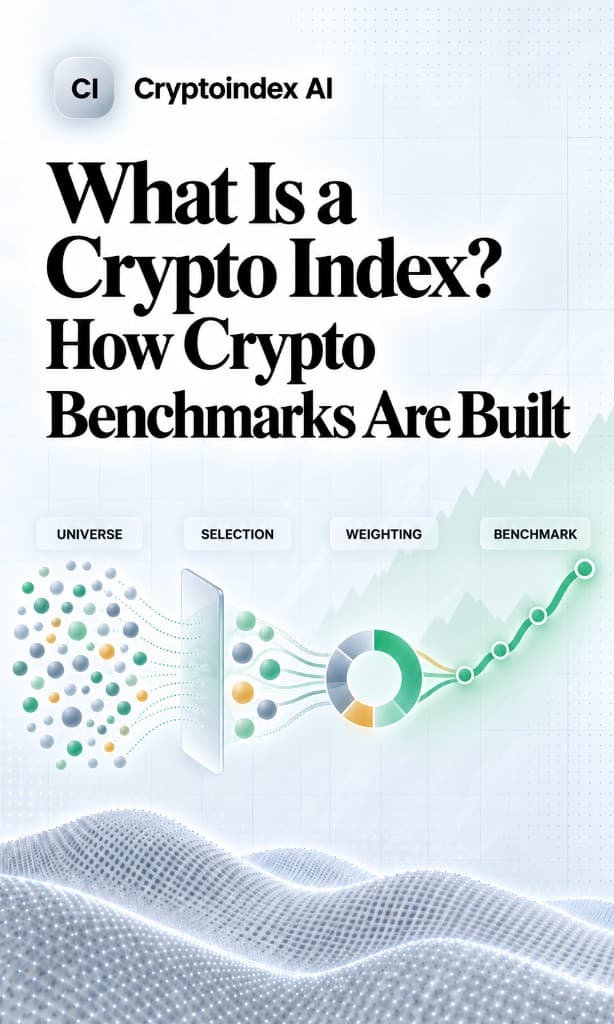
An index is not something you can hold. It is a rule for turning a messy market into one number, and changing the rule changes the number.
Open three crypto sites on the same morning and you will see three different numbers claiming to describe the same market. One says the market is up 1.2%. Another says 0.4%. A third says it is down slightly.
None of them is lying. They are measuring different things and calling it the same word.
That gap is the most useful place to start, because it tells you what an index actually is. An index is not a thing you can hold. It is a rule for turning a messy market into one number, and the rule is the whole product. Change the rule and the number changes, even though nothing in the market changed at all.
This guide covers what that rule has to specify, how to read one properly, and the three different objects people call an "index" without noticing they are different.
An index is a rule, not a basket
The simplest way to see it: an index is a recipe that anyone with the same data should be able to follow and get the same answer.
The recipe has to answer three questions, and every serious index publishes its answers in a document called a methodology.
Which assets are in it? The universe. Top ten by market cap. Everything above a liquidity floor. Only assets listed on exchanges in particular jurisdictions. Only layer-one tokens. The universe decides what the number is about.
How much does each one count? The weighting. Bitcoin can be 60% of an index, or 10%, or 3.3%, depending entirely on this choice. More on it shortly, because this is where most of the disagreement between indices lives.
When and how does it change? Maintenance. Markets move, new assets appear, old ones die. The rule has to say when the index notices, and what it does about it.
Everything else in a methodology document is detail hanging off those three. If you can answer all three for an index, you understand it. If you cannot, you are reading a number without knowing what it measures.
Weighting is where indices actually differ
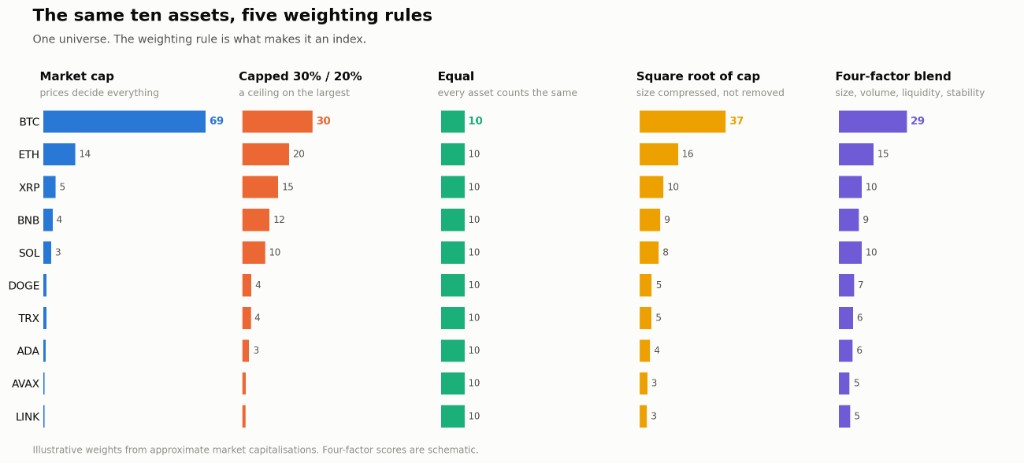
Give five providers the same ten assets and they will produce five different indices. The universe is often the boring part. Weighting is where the design decisions are.
Market capitalization weighting gives each asset a share proportional to its size. This is how most equity indices work and it is the default in crypto too. It is simple, it is cheap to track, and it has one obvious consequence: in a market where bitcoin is most of the value, a market-cap index is mostly a bitcoin index with decoration.
Capped weighting keeps market-cap logic but puts a ceiling on the largest holding. The CoinDesk 20 caps its biggest constituent at 30% and everything else at 20%. The cap is what turns a bitcoin proxy back into a market measure. It also creates a maintenance problem, because prices push the weight back above the cap between rebalances.
Equal weighting gives every asset the same share. Ten assets, 10% each. This sounds fair and behaves very differently: it is a systematic bet on smaller constituents, and it requires constant trading to maintain, because every price move pulls it off target.
Square-root weighting sits between the two. CCi30 weights thirty assets by the square root of market cap, which compresses the distance between the giant and the small without flattening it entirely. Bitcoin still leads, but not by the margin its raw size would give it.
Factor weighting uses more than size. CI100 blends market capitalization with trading volume, liquidity and volatility, so an asset that is large but thinly traded ranks below one that is slightly smaller and trades properly.
None of these is the right answer. They answer different questions. Market-cap weighting answers "where is the money." Equal weighting answers "how is the average asset doing." Factor weighting answers "where is the money that can actually move." Pick the one matching your question, and read the others knowing what they are.
The maintenance rules nobody reads
This is the least glamorous part of a methodology and it does more work than people expect.
Two separate operations hide behind the word "rebalancing."
Reconstitution changes which assets are in the index. Something drops out, something comes in.
Rebalancing resets the weights of the assets already there, back to what the rule says they should be.
They often happen on the same date, which is why they get conflated. They solve different problems. Reconstitution keeps the index representative. Rebalancing keeps it faithful to its own design.
Schedules vary widely. Bitwise reconstitutes its large-cap index monthly. The CoinDesk 20 and the Nasdaq family run quarterly. CI100 refreshes continuously, which makes it current and, by the same token, impossible for a real fund to replicate.
Then there are buffer rules, which exist because assets near the inclusion boundary swap positions constantly and chasing every swap costs money for no benefit. Bitwise requires a challenger to exceed the incumbent's free-float market cap by more than 10%, sustained across five consecutive days, before a swap happens. CoinDesk treats ranks 16 to 25 as a zone where incumbents keep priority. Both accept being slightly wrong about today's exact ranking in exchange for much less churn.
If you are ever tempted to skip the buffer in your own basket, this is the rule that saves you the most money. We go deeper on this in the rebalancing guide.
Three different things called "an index"
This is the distinction that causes the most confusion, and it is rarely spelled out.
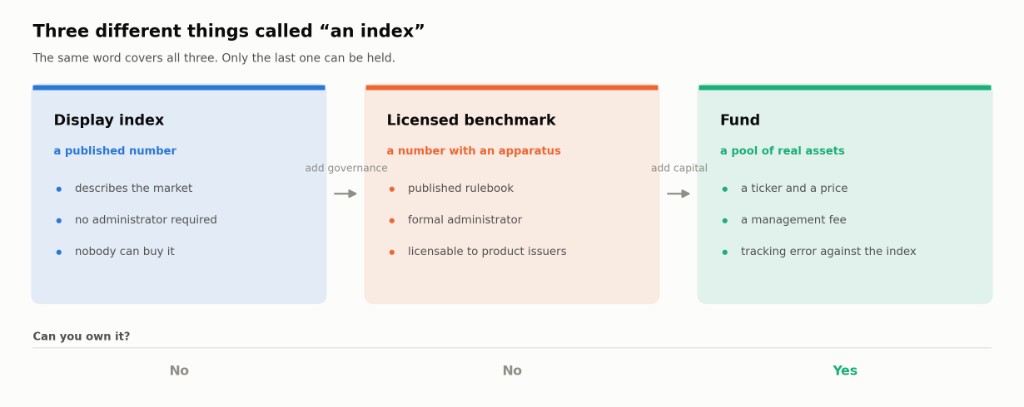
A display index is a published number. It exists to describe the market. Nobody can buy it, no fund tracks it, and nothing happens to anyone's money when it moves. Most of what you see on crypto data sites is this.
A licensed benchmark is a display index with a legal and operational layer on top. It has a formal administrator, a documented governance process, a published rulebook that cannot change quietly, and a licence that lets third parties build products on it. The CoinDesk 20 and the Nasdaq crypto indices are in this category. The number may look identical to a display index. The difference is the apparatus behind it.
A fund is an actual pool of assets that tries to track a benchmark. It has a ticker, a fee, a custodian and a tracking error. This is the only one of the three you can own.
Three different objects, one word. When someone says "I bought the index," they bought a fund, and the fund's return will differ from the index it tracks by at least the management fee and usually a little more.
The practical reason to care: a display index can show a return that no investor could have earned. It assumes no trading costs, no spreads, no slippage and instant rebalancing. That does not make it dishonest. It makes it a measurement rather than a promise.
Why two indices on the same market disagree
Back to the three numbers on three sites. Here is where the gap comes from, in rough order of how much it matters.
Different universes. An index of the top 10 and an index of the top 100 are measuring different markets. In a month where large caps lead, the top 10 looks stronger. In a broad rally, the top 100 does.
Stablecoins in or out. Some aggregate measures include stablecoins in total market capitalization, some do not. Since stablecoins are roughly a tenth of the total and by design do not move, including them mechanically dampens every percentage figure calculated against the total.
Different weighting. Covered above, and it is usually the biggest single contributor once the universe matches.
Different price sources. Which exchanges count, whether the price is a last trade or a volume-weighted average over a window, and what happens when one venue prints an outlier. Serious methodologies specify all of this, and the specifications differ.
Different timestamps. A number from 00:00 UTC and a number from 4 p.m. New York are not comparable, and in crypto the gap between them can be large.
None of this is a scandal. It is what happens when a continuous, fragmented, 24/7 market gets compressed into a single scalar. The useful habit is to stop asking which index is correct and start asking which question each one answers.
What an index is good for
Three uses, in rough order of how often they come up.
As a benchmark. This is the main one. Your portfolio is up 30%. Whether that is good depends entirely on what a passive basket did over the same window. Without the comparison, you are measuring effort rather than skill.
As the base for a product. Funds, futures and structured products all need something to reference. The benchmark's rules become the product's rules, which is why licensed benchmarks carry so much governance apparatus.
As a reading of market structure. Comparing indices against each other tells you things no single index can. A top-10 index outrunning a top-100 index means the rally is concentrated. A sector index outrunning a broad index means capital is rotating into that theme. The spread between two indices is often more informative than either level.
And one thing an index is not: a forecast. An index is a measurement of what happened. A backtest of an index is a measurement of what would have happened, built by someone who already knew how the story ended. Treat both as descriptions, never as predictions.
Five questions to ask about any index
A short checklist you can run in about two minutes, using the provider's methodology page.
- What is the universe, and who decides it? Rules-based screening or a committee?
- How is it weighted, and is there a cap? This single answer tells you most of what the index will do.
- How often does it change, and is there a buffer? Monthly, quarterly, continuous, and what friction is built in.
- Is this a display index, a licensed benchmark, or a fund? Three very different objects.
- Is the history live or backtested, and from when? A live record starting in 2018 and a simulation starting in 2015 are not the same evidence.
If the provider cannot answer all five from a published document, that is the answer.
Building one yourself
The fastest way to understand index construction is to build one and watch it misbehave.
Cryptoindex Pro lets you pick a universe, choose a weighting scheme, set a rebalance rule and replay the result through history. Build the same ten assets equal-weighted and market-cap-weighted, run both, and the difference between the two lines is the weighting decision with everything else held constant. That is the cleanest demonstration of the point this whole guide is making.
The usual caution applies. A backtest ignores trading costs, assumes you can always transact at the printed price, and is constructed with full knowledge of what happened next. It is a good way to understand how a rule behaves and a bad way to predict what it will earn.
Frequently asked questions
What is a crypto index in simple terms? A rule for combining several cryptocurrencies into one number that tracks how that group is doing. The rule specifies which assets are included, how much each one counts, and when the list changes.
Can you buy a crypto index? Not the index itself. You can buy a fund or product that tracks one. The fund's return will differ from the index by its fee and its tracking error.
What is the difference between a crypto index and a crypto index fund? The index is the rule and the number. The fund is a pool of real assets trying to follow it. The index has no fee and no trading costs; the fund has both.
Why do different crypto indices show different numbers? Because they use different universes, different weighting schemes, different price sources and different snapshot times. They are measuring different things with the same word.
Are crypto indices regulated? It depends on the index and the jurisdiction. A licensed benchmark used for financial products carries formal administration and governance requirements. A display index published for information does not.
How many assets should a crypto index hold? There is no correct number. Ten gives you the large caps and little else. A hundred gives you breadth and a long tail of thin names. The count matters less than the weighting, because in a cap-weighted index of a hundred assets, the bottom fifty may together account for a few percent.
The short version
An index is a rule, and the rule is the product. Three parts: which assets, how much each counts, and when it changes.
Weighting does most of the work. Market cap tells you where the money is, equal weighting tells you how the average asset is doing, factor weighting tells you where the tradeable money is. Maintenance rules and buffers are boring and they decide how much the thing costs to follow.
And the word covers three different objects. A display index describes, a licensed benchmark underwrites products, a fund is the only one you can own.
You can compare how the major crypto benchmarks are built side by side on the indices page, and every CI formula is published in full on the methodology page.
Cryptoindex.ai publishes display indices for informational purposes. They are not funds, licensed benchmarks or investable products. Backtests represent hypothetical historical performance and do not reflect trading costs. Nothing here is investment advice.