Index Methodology
Crypto Index Rebalancing: How Often Should a Basket Change?
Guides · Oct 1, 2026
GuidesRebalancingIndex Methodology

Rebalancing resets weights. Reconstitution changes the basket. Monthly, quarterly and continuous schedules do different jobs, and the weighting scheme drives turnover more than the calendar.
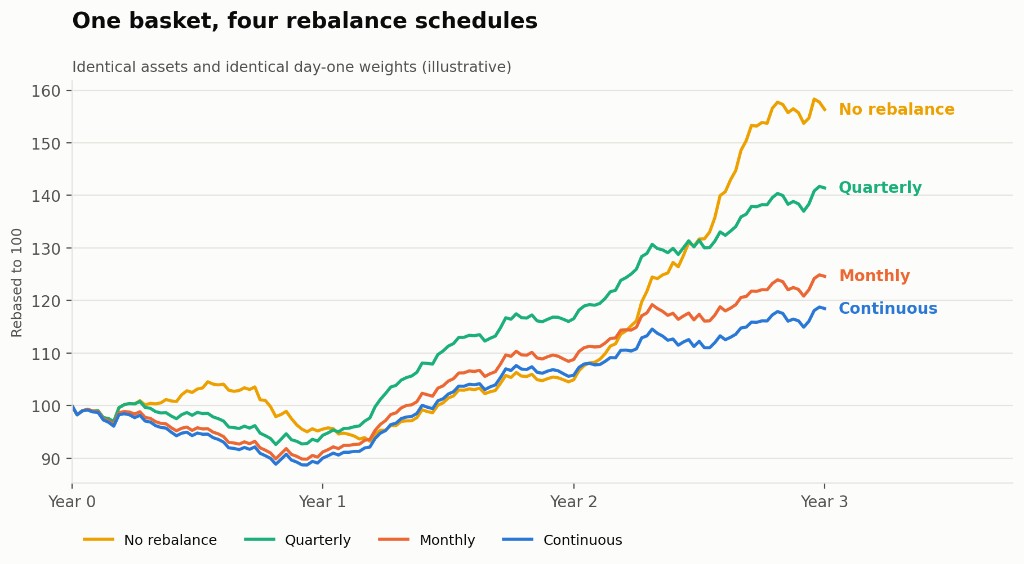
Two investors buy the same ten crypto assets at the same weights on the same day. One rebalances monthly, one never rebalances. Three years later they hold portfolios that look nothing alike, and the gap between their returns is larger than the gap between most competing funds.
Nothing separates them except a schedule.
Rebalancing is the least discussed and most consequential setting in index construction. This guide covers what it actually does, how the major crypto indices handle it, why turnover costs less than you would expect in some designs and far more in others, and how to choose a cadence that matches what you are trying to measure.
Two different operations, often confused
Index providers use two words and most articles blur them.
Rebalancing resets the weights of assets already in the index. If bitcoin's weight has drifted from 30% to 38% because it outperformed, rebalancing sells the excess and redistributes it.
Reconstitution changes which assets are in the index. An asset drops out, another comes in.
They often happen on the same date, which is why they get conflated, but they solve different problems. Reconstitution keeps the index representative of the market. Rebalancing keeps it faithful to its own rules.
An index can do one without the other. A fixed-constituent index can rebalance weights monthly and only reconstitute annually. A market-cap index arguably rebalances itself continuously, since weights follow prices automatically, and only needs explicit action when constituents change.
That last point is the one most people miss, and it explains a lot of confusing turnover data. More on it shortly.
What the major crypto indices do
| Index | Reconstitution | Notable mechanism |
|---|---|---|
| Bitwise 10 Large Cap | Monthly, last business day | 10% buffer over five consecutive days; possible same-day intraday rebalance |
| CoinDesk 20 | Quarterly, 4 p.m. ET | Top 15 automatic, ranks 16 to 25 form a buffer zone |
| Nasdaq CME Crypto Index | Quarterly | Eligibility gated on exchanges and custodians |
| CI100 | Continuous | Composition and weights refresh with each data pull |
Three different answers to the same question, and each is defensible for what that index is trying to be.
The case for monthly
Crypto rankings turn over much faster than equity rankings. An asset can enter and leave a top ten inside a single quarter. A monthly index sees that; a quarterly one may miss it entirely.
If your index exists to describe the market as it is right now, monthly reconstitution is closer to the truth.
The Bitwise 10 index goes further than most. Beyond its monthly cycle, its methodology includes a daily check at noon Eastern, and if a specific weight condition breaks, a rebalance fires at 4 p.m. the same day. That is as responsive as any major crypto index gets.
The case for quarterly
Every reconstitution means trading. Every trade costs spread, market impact and, in thin assets, slippage that can be substantial. Three times as many reconstitutions means roughly three times as many opportunities to pay those costs.
Quarterly also produces a more stable index to build products on. A fund tracking a quarterly benchmark has a predictable calendar and fewer taxable events in structures where that matters.
The CoinDesk 20 and the Nasdaq family both run quarterly, and both are designed as reference benchmarks for products rather than as real-time market descriptions. The cadence follows the purpose.
The case for continuous
If an index publishes no products and exists purely to describe market structure, there is no reason to lock weights at all.
CI100 works this way. Composition and weights refresh with every data pull, with five-minute prints. Nothing is frozen for a month or a quarter, which produces an unusually current picture.
The trade-off is explicit and worth stating plainly: a continuously rebalanced index is not replicable by a real portfolio. No fund can trade into continuous weight changes without costs that would overwhelm any tracking benefit. Continuous rebalancing buys accuracy at the price of implementability, which is the right trade for a display index and the wrong one for a fund.
The turnover surprise
Here is the finding that changes how most people think about this.
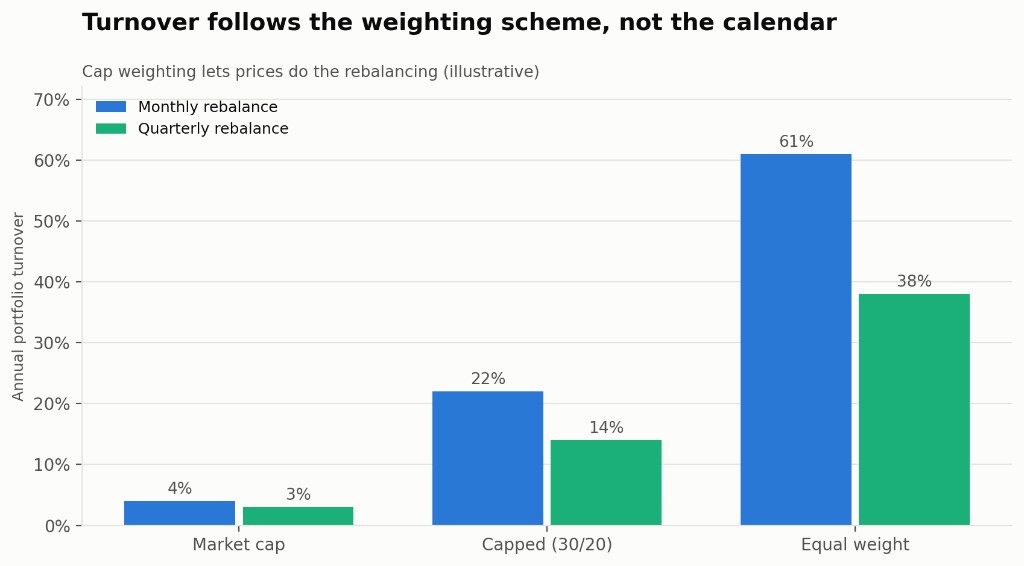
The Bitwise 10 fund rebalances monthly, three times as often as its quarterly competitors. You would expect heavy turnover. Its reported portfolio turnover has run around 3%, against a Digital Assets category average closer to 67%.
The explanation is the point made earlier. In a market-cap-weighted index, prices do most of the rebalancing for you.
If bitcoin rises 20% while everything else is flat, its market-cap weight rises automatically. The index does not need to trade to reflect that, because the weights are defined by market cap and market cap already moved. Actual trading is only required when constituents change, or when a rule forces weights away from where prices put them.
Which produces a counterintuitive hierarchy of turnover:
Lowest turnover: market-cap weighting. Prices do the work. Trades happen only at constituent changes.
Higher turnover: capped weighting. Every rebalance must pull the largest constituent back to its cap and redistribute the excess, which means trading against the market's drift.
Highest turnover: equal weighting. Every rebalance sells everything that outperformed and buys everything that lagged. This is maximum turnover by design, because the design is explicitly fighting drift.
So rebalancing frequency and turnover are not the same axis. A monthly cap-weighted index can turn over less than a quarterly equal-weighted one.
Buffer rules: the part that saves the most money
Every index that ranks by size faces the same annoyance. Assets near the inclusion boundary swap positions constantly, and mechanically following every swap generates trading that costs money and adds nothing.
So serious indices build in friction on purpose.
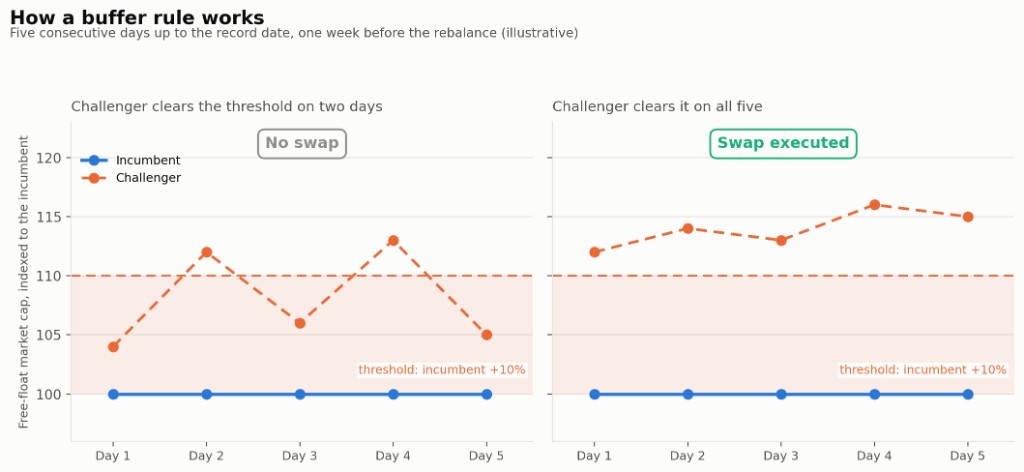
The Bitwise approach is a margin rule. An incumbent is removed only if a challenger exceeds its free-float market capitalization by more than 10%, and holds that margin on each of five consecutive days up to the record date one week before the rebalance. A brief spike past an incumbent does not trigger a swap.
The CoinDesk approach is a buffer zone. Assets ranked in the top 15 are included automatically. Positions 16 to 25 form a zone where existing constituents keep priority over newcomers. Only if the count still falls short do outsiders come in.
Both accept being slightly less accurate about today's exact ranking in exchange for materially less churn. In crypto, where an asset can move five places in a fortnight on narrative alone, that trade is clearly worth making.
If you build your own index and skip the buffer, you will discover this the expensive way.
Weight drift between rebalances
Between scheduled dates, weights move with prices. This matters more than most people account for.
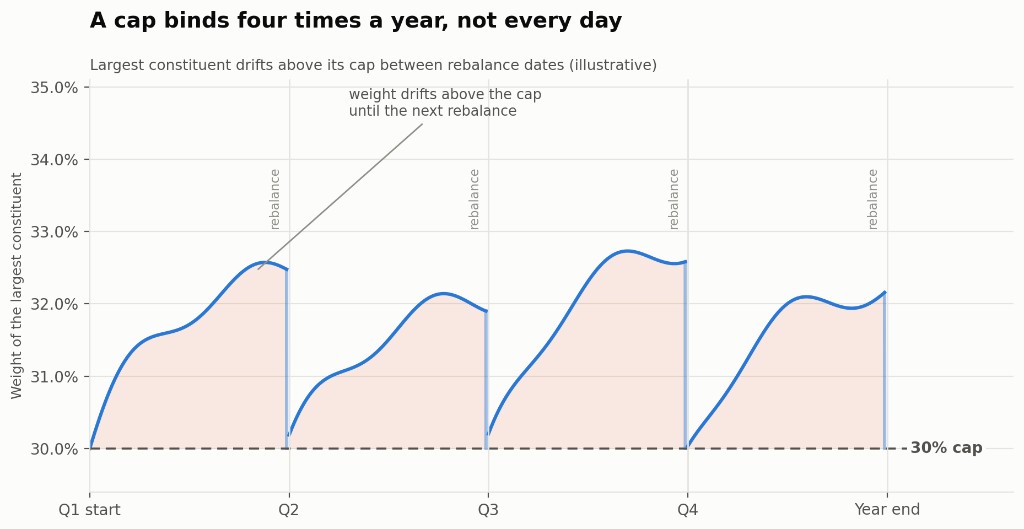
The CoinDesk 20 caps its largest constituent at 30%. That cap is enforced at rebalance, not continuously. If bitcoin rallies hard in the first month of a quarter, its weight rises above 30% and stays there until the next effective date.
So an index that describes itself as capped at 30% may be running at 35% for weeks at a time. This is not a flaw and it is fully disclosed in the methodology. It does mean the headline description of an index and its actual composition on a random Tuesday can differ meaningfully.
The same applies to any capped or equal-weighted construction. Only continuously rebalanced indices hold their stated weights at all times, and they pay for that with non-replicability.
Choosing a cadence for your own basket
If you are building rather than buying, four questions settle it.
What are you measuring? If you want to know what the market is doing right now, rebalance often or continuously. If you want something a real portfolio could follow, quarterly is the realistic answer.
What is your weighting scheme? Market-cap weighting needs less explicit rebalancing than anything else. Equal weighting needs the most, because it is fighting drift by design.
How liquid are your constituents? A basket of top-ten assets can be rebalanced cheaply. A basket with a long tail of thin names cannot, and frequent rebalancing there quietly transfers your returns to market makers.
Will you actually do it? This is the honest one. An index exists to impose a discipline most people will not follow voluntarily: selling what went up. A schedule you will not keep is worse than a longer schedule you will.
A reasonable default for most self-built baskets is quarterly with a buffer. It captures real composition changes, it does not chase noise, and it is a calendar a human being can maintain.
Testing a schedule before you commit
You do not have to guess which cadence suits your basket. You can test it.
Cryptoindex Pro lets you build a basket, set a rebalance rule, and replay how it would have behaved through history, with total return and maximum drawdown alongside. Build the same basket twice with different schedules and the difference between them is the schedule's contribution, isolated.
One methodological caution when you do this: change only the rebalance rule. If you also change constituents or weights, you are no longer measuring the schedule.
And the standard backtest caveats apply. Historical simulations ignore trading costs, which specifically understates the cost of frequent rebalancing, so a monthly schedule will always look better in a backtest than it would perform in reality. Treat a backtest as a description of how a rule behaves, not as a forecast.
Frequently asked questions
What is index rebalancing?
Resetting the weights of the assets in an index back to what its rules specify. Distinct from reconstitution, which changes which assets are in the index at all.
How often do crypto indices rebalance?
It varies by provider. The Bitwise 10 index reconstitutes monthly with a possible same-day intraday rebalance, the CoinDesk 20 and Nasdaq families run quarterly, and CI100 refreshes continuously.
Does more frequent rebalancing mean higher turnover?
Not necessarily. The weighting scheme matters more. In a market-cap-weighted index, prices do most of the rebalancing automatically, which is why a monthly cap-weighted fund can report turnover around 3% while its category averages closer to 67%.
What is a buffer rule?
A rule that requires a challenger to beat an incumbent by a clear margin, usually sustained over several days, before a swap happens. It prevents constant churn among assets sitting near the inclusion boundary.
How often should I rebalance my own crypto portfolio?
There is no universal answer, but quarterly with a buffer suits most self-managed baskets. It captures genuine composition changes without chasing noise, and it is a schedule people actually keep.
Can weights drift above their stated caps?
Yes. Caps are usually enforced at rebalance rather than continuously, so a constituent can exceed its cap between scheduled dates.
The short version
Rebalancing is where an index's stated design meets the market's actual movement, and the schedule decides how often those two get reconciled.
Monthly is more faithful to a fast-moving market. Quarterly is cheaper and more stable to build products on. Continuous is the most accurate and the least replicable. Buffer rules matter more than the calendar for keeping costs down, and the weighting scheme matters more than either for how much trading actually happens.
Formulas and rebalance rules for every CI index are published on the methodology page.
Cryptoindex.ai publishes display indices for informational purposes. They are not funds, licensed benchmarks or investable products. Backtests represent hypothetical historical performance and do not reflect trading costs. Nothing here is investment advice.