Research · Oct 9, 2026
The State of Crypto Indices 2026
 Alex· Research Analyst at Cryptoindex AIResearchFeesIndices
The US shipped an enormous amount of crypto index product this year. At the exposure layer it shipped one thing.
The US shipped an enormous amount of crypto index product this year. At the exposure layer it shipped one thing.
Cryptoindex Research. Figures as of 9 October 2026 unless stated. Methodology and sources at the end.
Summary of findings
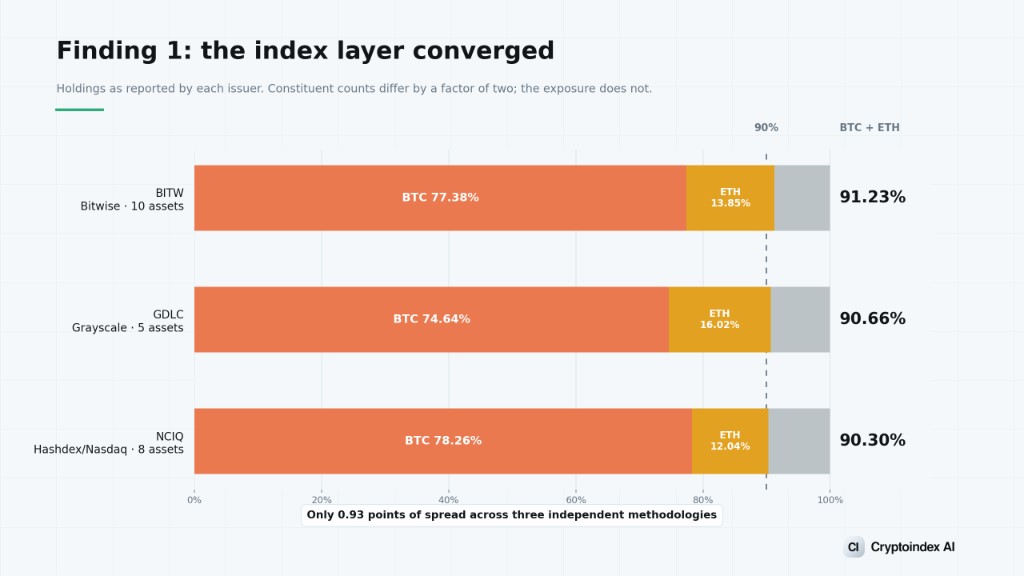
1. The index layer converged on a single exposure. Three major multi-asset crypto index funds, built by three independent providers on three separate methodologies, with five, eight and ten constituents respectively, all hold roughly 90% bitcoin and ether. The spread between them is 0.93 percentage points.
2. Constituent count does not predict diversification. The five-asset fund and the ten-asset fund have near-identical top-two concentration. In one of them, six of the ten holdings together account for 2.27% of the portfolio.
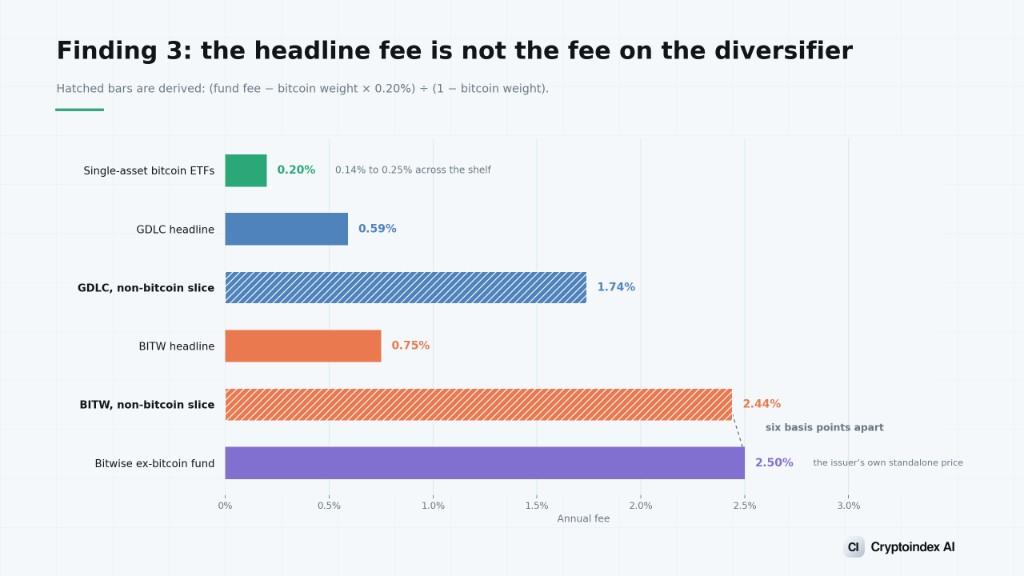
3. The headline fee understates what diversification costs. Netting out the bitcoin slice at the price of a standalone bitcoin ETF, the effective annual fee on the non-bitcoin portion of these products runs between 1.74% and 2.44%, against headline fees of 0.59% and 0.75%.
4. The market has already priced that exposure, and withdrawn it. The one dedicated ex-bitcoin index fund from a major provider was priced at 2.50%, close to what the blended fee implies. It is closed to new investment and winding down.
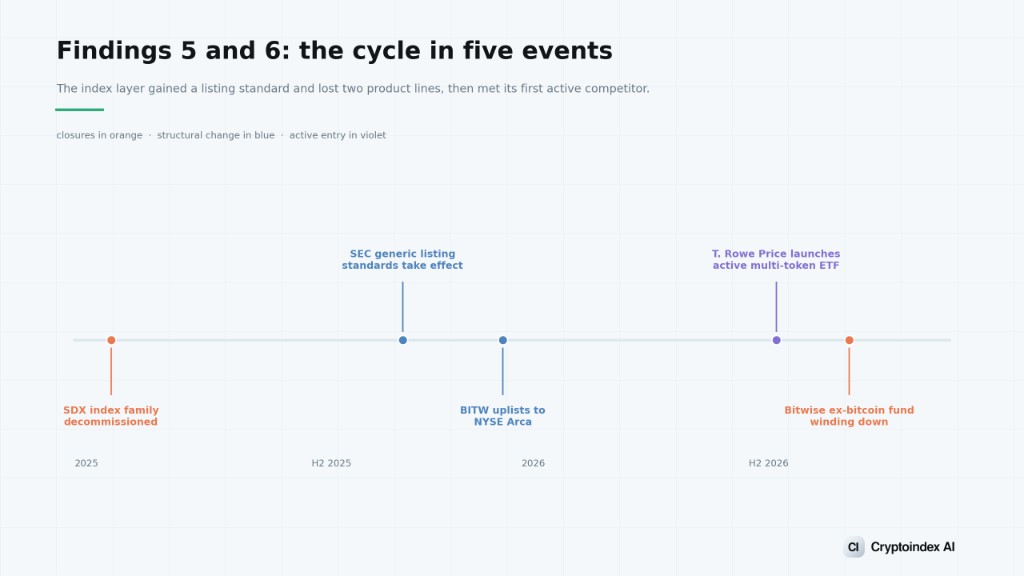
5. Wrapper risk is real and largely undiscussed. The largest crypto index fund traded below its net asset value on 139 of 191 trading days in 2026 to date, having uplisted from an over-the-counter trust to a listed ETP only in December 2025.
6. The first large traditional manager to enter multi-asset crypto rejected indexing. T. Rowe Price, with $1.9 trillion under management, launched an actively managed multi-token ETF in July 2026 rather than tracking an index.
1. The regulatory shift and the product wave
The structural change that defines 2026 happened at the listing standards layer rather than in any single approval.
The SEC's generic listing standards for crypto exchange-traded products cut the path to listing from as much as 240 days under the old 19b-4 rule-change process to roughly 75 days. The effect was immediate and quantitative rather than rhetorical.
Through 2025, dozens of single-asset altcoin ETFs reached market, covering Solana, XRP, Dogecoin and Chainlink among others. Bloomberg Intelligence counts more than 126 further crypto ETP filings pending. Bitwise projects more than 100 new US crypto ETF launches in 2026.
Flows concentrated where the products were simplest. Bitcoin ETFs took approximately $22 billion in net inflows across 2025; ether ETFs took just under $10 billion, with $9.3 billion of that arriving in July and August alone. By one estimate from BNY's asset servicing arm, bitcoin ETFs now hold around 7% of global bitcoin supply.
Two observations follow, and they pull in opposite directions.
The first is that the category is no longer speculative infrastructure. A product set holding that share of an asset's supply is a structural participant in it.
The second is that almost none of this was index product. The wave was single-asset. Bloomberg Intelligence has separately warned that under-subscribed funds will begin liquidating in late 2026 and 2027, which is the normal end state of a launch cycle driven by shelf space rather than demand.
2. What the index layer actually holds
We pulled the published holdings of the three largest multi-asset crypto index funds available to US investors.
| Fund | Provider | Constituents | Bitcoin | Ether | BTC + ETH | Holdings as of |
|---|---|---|---|---|---|---|
| BITW | Bitwise | 10 | 77.38% | 13.85% | 91.23% | 11 Aug 2026 |
| GDLC | Grayscale | 5 | 74.64% | 16.02% | 90.66% | 31 Oct 2025 |
| NCIQ | Hashdex / Nasdaq | 8 | 78.26% | 12.04% | 90.30% | 12 Aug 2026 |
Three providers who do not coordinate. Three separate methodologies with different eligibility screens, rebalance schedules and buffer rules. Constituent counts differing by a factor of two.
Spread between them: 0.93 percentage points.
A more recent disclosure for BITW, dated 6 October 2026, shows 75.44% bitcoin and 14.12% ether, so the convergence is not an artefact of a single snapshot date.
The distribution inside the basket is more lopsided than the top-two figure suggests. BITW's full holdings at 11 August 2026 ran: XRP 3.82%, Solana 2.68%, Hyperliquid 0.77%, Cardano 0.42%, Chainlink 0.38%, Stellar 0.33%, Litecoin 0.21%, Sui 0.16%. The bottom six holdings came to 2.27% between them. A doubling in the smallest position moves the fund by 0.16%.
None of this is concealed and none of it is poor design. Each fund does what its published methodology says. BITW tracks a free-float market-cap-weighted index of the largest eligible assets, reconstitutes monthly, and applies a buffer rule requiring a challenger to exceed an incumbent by more than 10% across five consecutive days.
The finding is structural rather than critical: market-cap weighting reproduces the concentration of the market it measures. Where two assets are most of a market's value, a cap-weighted basket of that market is mostly those two assets, whether it holds five names or fifty. Adding constituents at the bottom of a ranked list adds names, not exposure.
3. Fees, and the number that is not published
Headline fees in this category span a wide range and understate the dispersion.
| Product | Type | Fee |
|---|---|---|
| Morgan Stanley Bitcoin Trust (MSBT) | Single asset | 0.14% |
| Bitwise Bitcoin ETF (BITB) | Single asset | 0.20% |
| iShares Bitcoin Trust (IBIT) | Single asset | 0.25% |
| Fidelity Wise Origin Bitcoin Fund (FBTC) | Single asset | 0.25% |
| Grayscale CoinDesk Crypto 5 (GDLC) | Multi-asset index | 0.59% |
| Bitwise 10 Crypto Index ETF (BITW) | Multi-asset index | 0.75% |
| T. Rowe Price Active Crypto ETF (TKNZ) | Multi-asset active | 0.75%, rising to 0.90% |
| Bitwise 10 ex Bitcoin Crypto Index Fund | Ex-bitcoin index, closing | 2.50% investor / 2.00% institutional |
Single-asset bitcoin exposure clusters tightly between 0.14% and 0.25%. Multi-asset index products sit at three to four times that level. The question a buyer should ask is what the premium is buying, and the answer is arithmetic.
An effective fee on the non-bitcoin exposure
Because these funds are predominantly bitcoin, the headline fee is charged largely on exposure available separately at a quarter of the price. Netting that out isolates what the remaining exposure actually costs.
The calculation, using the cheapest credible single-asset benchmark of 0.20%:
effective fee = (fund fee − bitcoin weight × 0.20%) ÷ (1 − bitcoin weight)
| Fund | Headline fee | Bitcoin weight | Effective fee on the rest |
|---|---|---|---|
| BITW | 0.75% | 75.44% | 2.44% |
| GDLC | 0.59% | 74.64% | 1.74% |
So the accurate description of BITW is not "a diversified basket for 0.75%". It is a bitcoin ETF at roughly market rate bundled with an ether-and-alts sleeve priced near 2.4%, sold as a single blended number.
Blended fees are standard practice across the fund industry and the headline figures are accurate. The point is that the blend obscures the only decision a buyer is actually making.
The validation for this arithmetic is unusually direct. Bitwise sold that exposure separately, in a dedicated ex-bitcoin index fund, at 2.50% for investor shares. The issuer's own standalone price for the non-bitcoin sleeve lands within six basis points of what our calculation implies from its blended product.
We work through the full derivation in crypto index fund vs bitcoin.
4. Wrapper risk: what you own is not always what it holds
A cost component that appears in no fee table.
BITW is an exchange-traded product whose market price and net asset value are separate numbers. The issuer publishes the divergence history. For 2026 to date:
- Traded at a discount to NAV on 139 days
- Traded at a premium on 46 days
- Traded at NAV on 6 days
That is 191 trading days, with the fund below the value of its own holdings on 73% of them.
The structural explanation matters. BITW existed as an over-the-counter trust from November 2017 and only uplisted to NYSE Arca on 9 December 2025. Products in that older structure were known for persistent and sometimes large discounts, because no efficient creation and redemption mechanism existed to close the gap. The 2026 record suggests the listing is working but has not yet fully normalised: the price sat at a 0.06% premium on 5 October 2026.
A further structural note taken from the issuer's own disclosure: the fund is not registered under the Investment Company Act of 1940 and not regulated under the Commodity Exchange Act, so it does not carry the protections those frameworks provide. It describes itself as nondiversified.
For an allocator, the implication is that wrapper selection is a separate decision from index selection, and the two are often discussed as if they were one.
5. What has already been tried and withdrawn
A research review that only counts launches misreads a market. Two closures this cycle are more informative than most of the openings.
The ex-bitcoin index fund. Bitwise operated a dedicated ex-bitcoin large-cap index fund, offered to accredited investors under Regulation D, priced at 2.50% and 2.00%. It is closed to new investment and winding down. The single most direct answer to "I want crypto exposure that is not bitcoin" existed as a product, was priced where the arithmetic says it should be, and did not gather enough assets to continue.
The SIX Digital Exchange index family. SDX BTC, SDX ETH and the SDX Bi-Cap index were decommissioned on 31 January 2025. The announcement stated explicitly that they would not be transitioned to alternative indices. The Bi-Cap had been set at 1,000 points on 2 August 2019 and the family was announced in September 2021. SIX's own CMI10, with a base of 1,000 points at 30 December 2016 and live calculation from 9 January 2018, continues. We documented the decommissioning and what replaced it in the SDX analysis.
The pattern across both: index products that answer a narrower question than "give me the large caps" have struggled to reach scale, regardless of whether the methodology was sound.
6. The active challenge
The most consequential entry of 2026 was not an index product.
On 16 July 2026, T. Rowe Price, which oversees $1.9 trillion in assets, launched the T. Rowe Price Active Crypto ETF (TKNZ), which it describes as the industry's first actively managed multi-token spot crypto ETF. It carries a 0.75% net management fee under a waiver through May 2027, scheduled to rise to 0.90% thereafter, and holds a basket including bitcoin, ether, BNB, XRP, Solana and Hyperliquid.
The stated rationale is a direct argument against index tracking: rather than following a fixed rule, managers can shift allocations based on market conditions, research and risk assessment, in order to capture rotations in market leadership.
This is a meaningful test and it is worth stating the case on both sides.
The case for the active approach is the finding in section 2. If a cap-weighted index of this market is 90% two assets regardless of how many names it holds, then an investor seeking genuine diversification cannot get it from the passive wrapper as currently constructed. Discretion is one way around a rule that produces an unwanted outcome.
The case against is the one critics raise, and it is the standard one: active funds charge more and must outperform consistently to justify it. At 0.90% against a 0.59% index alternative, the hurdle is roughly 31 basis points a year before the manager adds anything.
There is a third possibility that neither framing covers, and it is the one this research points toward. The problem that TKNZ solves with discretion is also solvable with a different rule. Capping, square-root weighting and multi-factor weighting all cut top-two concentration materially without introducing manager risk. The industry reached for discretion before it had exhausted the rule space.
7. Where the rule space actually goes
Applying four published weighting rules to the same ten-asset universe, calibrated to a real fund's disclosed weights, produces the following top-two concentration:
| Weighting rule | BTC + ETH weight | What it costs |
|---|---|---|
| Market cap | ~91% | Nothing to run, maximum concentration |
| Square root of market cap | ~64% | Ordering preserved, no cliff, moderate turnover |
| Capped 30% / 20% | ~50% | Trades against drift at every rebalance |
| Four-factor blend | ~46% | More moving parts, more judgment in the rule |
| Equal weight | 20% | Highest turnover, systematic bet on small constituents |
Each is a different answer to the same question and each costs something. Market-cap weighting is popular precisely because it is cheap, replicable and self-maintaining, and those are genuine engineering virtues rather than marketing ones. In a cap-weighted basket prices do the rebalancing; every other scheme fights drift and pays spread to do it.
The conclusion is not that one rule is correct. It is that the gap between a 91% top-two concentration and a 50% one is a design decision, available today, published in full, requiring no discretion and no manager. The reason the shelf does not offer it is distribution economics rather than methodology.
Construction details for every benchmark referenced here are on the indices page, and the full formulas, including weighting and rebalance rules, are on the methodology page.
Frequently asked questions
How much of a crypto index fund is bitcoin? In a market-cap-weighted fund, close to bitcoin's share of the eligible universe. The three largest multi-asset crypto index funds held between 74.64% and 78.26% bitcoin on their most recent disclosures, with bitcoin and ether together at 90.30% to 91.23%.
What is the average fee on a crypto index fund? Multi-asset index products in the US charge between 0.59% and 0.75%. Single-asset bitcoin ETFs cluster between 0.14% and 0.25%. The actively managed multi-token alternative charges 0.75% rising to 0.90%.
Which crypto index fund is the most diversified? On top-two concentration, the three largest are within one percentage point of each other, so the question does not separate them. Diversification in an index comes from the weighting rule rather than the constituent count.
Are crypto index funds growing? The product count is growing rapidly. Bloomberg Intelligence counts over 126 pending crypto ETP filings and Bitwise projects more than 100 US launches in 2026. Most of that is single-asset rather than index product, and liquidations of under-subscribed funds are expected in late 2026 and 2027.
Has any crypto index been discontinued? Yes. The SIX Digital Exchange index family, covering SDX BTC, SDX ETH and the SDX Bi-Cap, was decommissioned on 31 January 2025 with no successor index. Bitwise's dedicated ex-bitcoin index fund is closed to new investment and winding down.
What is the difference between an index and an index fund? The index is a published rule and the number it produces. The fund is a pool of real assets attempting to track it, with a fee, a custodian and a tracking error. Only the fund can be owned.
Methodology and sources
Holdings. Fund compositions are taken from issuer disclosures and public ETF data providers on the dates stated in each table. Where two disclosure dates exist for the same fund, both are shown rather than averaged.
Effective fee calculation. Defined as (fund fee − bitcoin weight × single-asset bitcoin ETF fee) ÷ (1 − bitcoin weight), using 0.20% as the single-asset benchmark, that being the cheapest fee charged by a major issuer that also operates one of the index funds reviewed. Using 0.25% instead reduces the BITW figure from 2.44% to 2.29%.
Weighting rule comparison. Section 7 applies each published rule to a single ten-asset universe calibrated to BITW's disclosed weights, scaled so bitcoin equals its reported market capitalization. Four-factor scores are illustrative. The purpose is to isolate the effect of the rule, since using live compositions would mix universe differences with weighting differences.
Market data. Total crypto market capitalization, bitcoin dominance and stablecoin share from CoinGecko, 7 October 2026.
Limitations. Fund holdings, fees and status change without notice. Three funds are not a census of the category; they are the largest multi-asset index products available to US investors at the time of writing. Nothing in this report is a performance comparison, and no forward-looking claim is made about any product.
Cryptoindex.ai publishes display indices for informational purposes. They are not funds, licensed benchmarks or investable products. Cryptoindex.ai is not affiliated with Bitwise, Grayscale, Hashdex, Nasdaq, T. Rowe Price, BlackRock, Fidelity, Morgan Stanley, SIX or CoinDesk Indices. This report is research, not investment advice. Figures are as of the dates stated; verify against current issuer documents before acting.