Funds · Oct 8, 2026
Crypto Index Fund vs Bitcoin: What You Actually Pay For
 Melanya· Editors & WritersFundsBitcoinFees
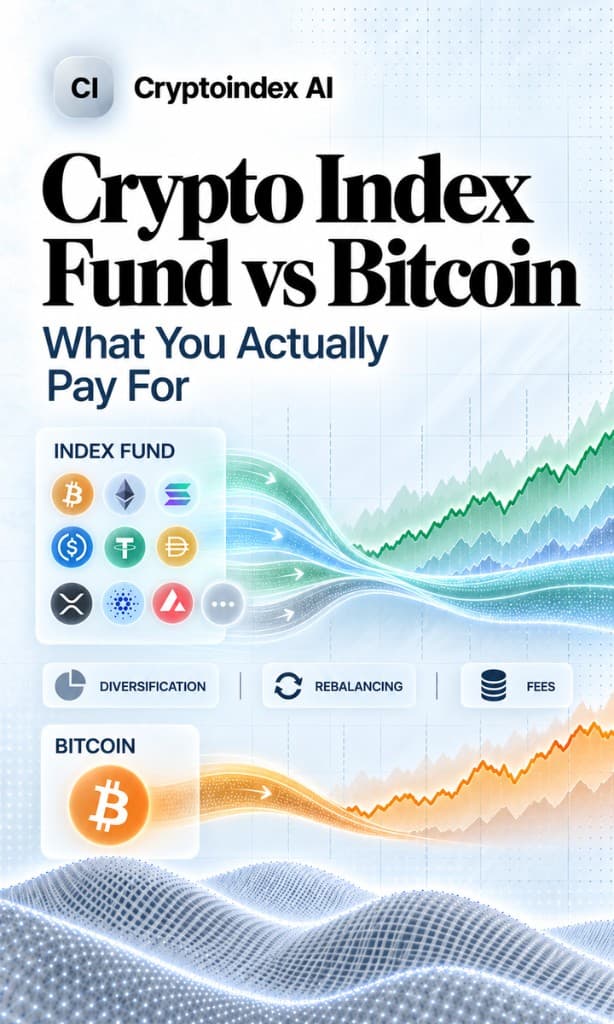
BITW was 75.44% bitcoin on 6 October 2026 and charges 0.75%. Price that slice at 0.20% and the rest of the fund costs about 2.44% a year.
The question comes up constantly and it is a reasonable one. You want crypto exposure, you do not want to manage ten wallets, and there is a listed index fund that holds the ten largest assets for a single fee. Is that better than just buying bitcoin?
Most answers to this get argued on principle: diversification good, concentration bad, or the reverse. Nobody opens the holdings file.
So let us open it. The Bitwise 10 Crypto Index ETF, the largest crypto index fund in the US, discloses its composition daily. As of 6 October 2026 it was 75.44% bitcoin and 14.12% ether. Just under 90% of the fund is two assets you can buy individually, cheaply, from a dozen issuers.
The fund charges a 0.75% sponsor fee on all of it.
That sets up an arithmetic problem that almost nobody runs, and the answer is the most useful thing in this article: once you account for the fact that three quarters of the fund is bitcoin you could have bought for 0.20%, the effective annual fee you are paying for the non-bitcoin part of the portfolio is roughly 2.4%.
Not 0.75%. Around 2.4%, on the only part of the product that makes it different from a bitcoin ETF.
Here is the full working, plus a second cost that no fact sheet highlights, and an honest account of when an index fund is still the right purchase.
TL;DR
- BITW held 75.44% bitcoin and 14.12% ether as of 6 October 2026. Just under 90% of a ten-asset "diversified" fund is two assets.
- It charges 0.75% a year. A spot bitcoin ETF from the same issuer charges 0.20%. Most spot bitcoin ETFs sit between 0.14% and 0.25%.
- Strip out the bitcoin slice at its own market price and the remaining 24.56% of the fund carries an effective fee of about 2.4% a year. That is what the diversification actually costs, and it is not a number anybody prints.
- There is a second cost. In 2026 to date BITW traded below its net asset value on 139 of 191 days, at a premium on 46 and at NAV on 6. If you bought and sold on market, the spread to NAV was a real and mostly adverse part of your return.
- The market has already tested the alternative. Bitwise ran a dedicated ex-bitcoin index fund priced at 2.50% for investor shares. It is now closed to new investment and winding down.
- The index fund still makes sense in specific cases, listed below. It just is not the case most buyers think they are making.
First, what you actually own
Holdings as reported by the issuer for 6 October 2026, with the fund's own stated weights:
| Asset | Weight |
|---|---|
| Bitcoin | 75.44% |
| Ethereum | 14.12% |
| Everything else (eight assets) | ~10.44% |
A separate disclosure a few weeks earlier, on 11 August 2026, broke out the full list: XRP at 3.82%, Solana 2.68%, Hyperliquid 0.77%, Cardano 0.42%, Chainlink 0.38%, Stellar 0.33%, Litecoin 0.21% and Sui 0.16%. The bottom six holdings came to 2.27% between them.
None of this is hidden and none of it is a defect. The fund tracks a free-float market-cap-weighted index of the ten largest eligible assets and reconstitutes monthly, with a buffer rule requiring a challenger to beat an incumbent by more than 10% across five consecutive days. That is careful index engineering, honestly disclosed. We went through why every cap-weighted crypto index lands in roughly the same place in our piece on index concentration.
The point is narrower. If you buy this fund, three quarters of your money is in bitcoin whether you wanted that or not.
The fee arithmetic nobody runs
Now the part that changes the decision.
BITW's sponsor fee is 0.75% per year, charged on the whole portfolio. Here is what the comparable components cost separately, as of early October 2026:
| Product | Fee |
|---|---|
| Bitwise Bitcoin ETF (BITB) | 0.20% |
| iShares Bitcoin Trust (IBIT) | 0.25% |
| Fidelity Wise Origin Bitcoin Fund (FBTC) | 0.25% |
| Morgan Stanley Bitcoin Trust (MSBT) | 0.14% |
| Bitwise 10 Crypto Index ETF (BITW) | 0.75% |
| Grayscale CoinDesk Crypto 5 (GDLC) | 0.59% |
Use BITB for the comparison, because it is the same issuer, which removes any suspicion of a cherry-picked benchmark.
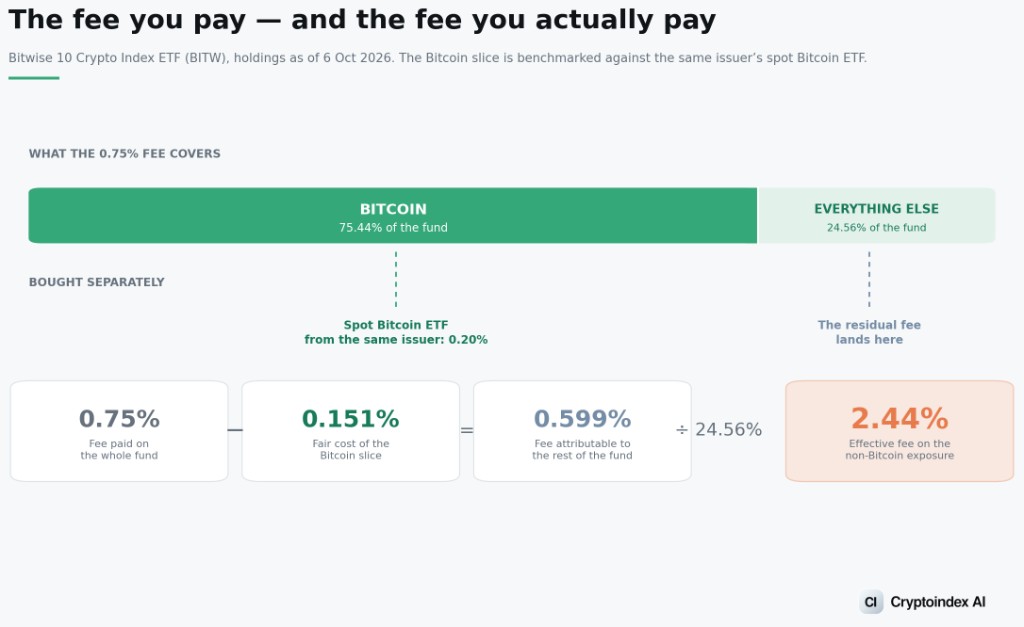
Step one. 75.44% of BITW is bitcoin. If you held that slice directly through BITB at 0.20%, it would cost you 0.7544 × 0.20% = 0.151% of total assets per year.
Step two. You are paying 0.75% of total assets. Subtract the fair cost of the bitcoin slice and the fee attributable to everything else is 0.75% − 0.151% = 0.599% of total assets.
Step three. That 0.599% is being charged for exposure to the remaining 24.56% of the portfolio. Expressed as a fee on the thing it is actually buying:
0.599% ÷ 0.2456 = 2.44% per year.
Against IBIT or FBTC at 0.25% the figure is about 2.29%. Either way it lands between 2.3% and 2.5%.
So the honest description of this product is not "a diversified crypto basket for 0.75%". It is "a bitcoin ETF at roughly market rate, bundled with an ether-and-alts sleeve priced around 2.4%, sold as a single blended fee of 0.75%."
That framing is not an accusation. Blended fees are completely standard across the fund industry, and the 0.75% headline is accurate. But bundling obscures the question any buyer should be asking, which is whether that 24.56% sleeve is worth 2.4% a year to them.
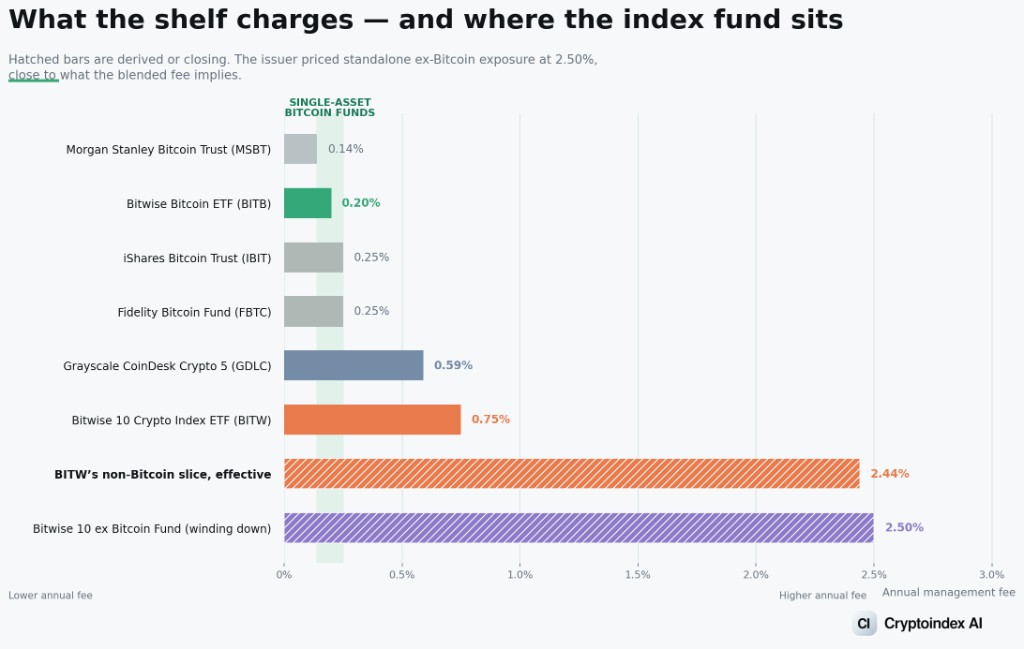
And here is the detail that makes the number feel less like a thought experiment. Bitwise ran a dedicated ex-bitcoin index fund, holding the same large-cap universe with bitcoin removed, priced at 2.50% for investor shares and 2.00% for institutional. In other words, when the issuer sold that exposure on its own, it priced it at roughly the 2.4% our arithmetic implies.
That fund is now closed to new investment and winding down.
The second cost: you probably bought at a discount, and that is the good news
Fees are the cost everyone checks. This one is not on any fact sheet front page.
BITW is an exchange-traded product whose market price and net asset value are two different numbers. The issuer publishes the history, and for 2026 to date it reads:
- Traded at a discount to NAV on 139 days
- Traded at a premium on 46 days
- Traded at NAV on 6 days
That is 191 trading days, and the fund was below the value of its own holdings on 73% of them.
What this means in practice depends entirely on which side you were on. If you bought during a discount, you acquired the underlying assets for less than they were worth, which is a benefit. If you sold during one, you took less than they were worth. And since discounts dominated the year, a buy-and-hold investor who entered and exited at random points was more likely than not to have bought cheap and sold cheap, with the net effect depending on the two spreads rather than the average.
The reason to care is not that discounts are inherently bad. It is that the spread to NAV is a component of your return that does not appear in any fee table, and for this fund in this year it was present on the large majority of days.
The structural background matters too. BITW existed as an over-the-counter trust from November 2017 and only uplisted to NYSE Arca on 9 December 2025. Products in that older structure were known for persistent, sometimes very large discounts, because there was no efficient creation and redemption mechanism to close the gap. The current price sat at a 0.06% premium to NAV on 5 October 2026, which suggests the listing is doing its job. The 2026 record shows the adjustment has not been uniform.
One more structural note, from the issuer's own language: the fund is not registered under the Investment Company Act of 1940 and is not regulated under the Commodity Exchange Act, so it does not carry the protections those frameworks provide. It also describes itself as nondiversified. Worth reading before you treat it as equivalent to a conventional ETF.
When the index fund is genuinely the right purchase
Having spent two sections on costs, here is the other side, because for a meaningful set of buyers this product is the correct choice and the arithmetic above is beside the point.
You want one line on a brokerage statement. This is the biggest real reason and it is not trivial. One ticker, one cost basis, one tax lot structure, no exchange accounts, no wallets, no seed phrases, no self-custody risk. For a large number of people the 0.75% is buying the removal of an entire category of operational failure, and that is worth paying for.
You are investing inside a wrapper that cannot hold crypto directly. Retirement and tax-advantaged accounts in many jurisdictions can hold a listed security and cannot hold a token. If the index fund is the only route, the fee comparison with spot products is academic.
You want the rebalancing to happen without you. The fund reconstitutes monthly and applies its buffer rule mechanically. Running that yourself means watching rankings, trading eight small positions and paying spreads on thin assets. Most people who intend to do this do not.
You want exposure to assets you would not otherwise buy. Sui at 0.16% of a portfolio is not a position you would open deliberately. As part of a rules-based basket, it is a systematic allocation to whatever happens to be large, which is a defensible thing to want.
You value the index discipline itself. A published rule with a buffer and a reconstitution calendar removes discretion from a decision most people make badly. That has value independent of cost.
What the index fund is not, on current holdings, is a way to materially reduce your bitcoin exposure. If that is your goal, you need a different mechanism.
If you want something that behaves differently from bitcoin
The lever is the weighting rule, not the number of assets.
A cap-weighted index inherits whatever concentration the market already has, which is why adding constituents at the bottom of the list changes the exposure almost not at all. Every alternative design is an answer to that:
Capping truncates the largest holding. A 30% cap turns a bitcoin proxy back into a market measure, though caps usually bind at rebalance rather than continuously, so live weights drift above the stated ceiling.
Square-root weighting compresses the distribution smoothly instead of cutting it off.
Factor weighting measures other things alongside size. CI100 blends market capitalization with trading volume, liquidity and volatility, so an asset that is large but thinly traded does not get credit for size it could not convert into a fill.
Exclusion settles it outright. CI-Alts removes bitcoin from the frame, which is a different question rather than a tilt.
An honest caveat, because the ex-bitcoin fund winding down is relevant here. The CI indices are display indices: published numbers for measuring the market, not funds you can buy. That is why they can refresh continuously and run rules a real portfolio could not execute cheaply. The full formulas are on the methodology page. If you want to see how a different rule would have behaved on your own basket, Cryptoindex Pro lets you build it and replay it, with the usual caveat that a backtest carries no trading costs and is assembled by someone who already knows how the story ended.
Run this check yourself in four steps
The method generalises to any index product, including ones launched after this article.
1. Pull the holdings and find the top weight. Every listed fund publishes this. If the largest holding is above 70%, you are buying that asset with decorations.
2. Look up what the top holding costs on its own. For bitcoin and ether there are single-asset products at a fraction of the index fee. Note the cheapest credible one.
3. Do the subtraction. Fund fee, minus (top weight × single-asset fee), divided by (1 − top weight). That is the effective fee on the part of the fund that is not the top holding. It is usually several times the headline number.
4. Check the premium and discount history. It is published and almost nobody reads it. A fund that trades away from NAV most of the year has a cost component that no fee table shows.
Four numbers, about five minutes, and it tells you more than any amount of marketing copy.
Frequently asked questions
Is a crypto index fund better than just buying bitcoin? It depends on what you want. On current holdings a leading crypto index fund is about 75% bitcoin, so it is mostly a bitcoin position with a smaller allocation to ether and eight minor assets. If you want one ticker, no custody and automatic rebalancing, the fund delivers that. If your goal is materially less bitcoin exposure, cap-weighted index funds do not provide it.
What does BITW charge? The sponsor fee is 0.75% per year as of October 2026. For comparison, spot bitcoin ETFs generally charge between 0.14% and 0.25%, and Grayscale's five-asset index product charges 0.59%.
Why is the effective fee on the non-bitcoin part so much higher? Because the 0.75% is charged on the whole portfolio while three quarters of it is bitcoin you could buy for around 0.20%. Netting out the fair cost of the bitcoin slice leaves about 0.60% of total assets being charged for the 24.56% that is not bitcoin, which works out to roughly 2.4% on that slice.
How much of a crypto index fund is bitcoin? In a market-cap-weighted index fund, close to bitcoin's share of the eligible universe. BITW was 75.44% bitcoin and 14.12% ether on 6 October 2026. Grayscale's GDLC was 74.64% and 16.02%.
Does BITW trade at a premium or a discount? Both, at different times. In 2026 to date the issuer reports a discount on 139 days, a premium on 46 and parity on 6. It uplisted from an OTC trust to NYSE Arca in December 2025, which should narrow the gap over time.
Is there an ex-bitcoin crypto index fund? Bitwise operated one, priced at 2.50% for investor shares, available only to accredited investors. It is closed to new investment and winding down. Ex-bitcoin exposure is currently easier to find as a published index than as a purchasable fund.
How do I invest in a crypto index? Either buy a listed index fund, accepting its weighting rule and fee, or replicate a rule yourself using single-asset products and spot holdings. The first is simpler, the second is cheaper and requires you to actually do the rebalancing.
The short version
A crypto index fund and a bitcoin position are closer to the same trade than the marketing suggests, because a cap-weighted index inherits the market's own concentration. BITW was 75.44% bitcoin on 6 October 2026.
The fee follows from that. 0.75% on a portfolio that is three quarters bitcoin means the quarter that is not bitcoin is effectively costing you around 2.4% a year, which is close to what the same issuer charged when it sold that exposure separately, in a fund now winding down.
Then there is the spread to NAV, present on 185 of 191 days this year and adverse on 139 of them, which appears in no fee table at all.
None of this makes the product wrong. One ticker, no custody and mechanical rebalancing are worth real money to real people, and for anyone investing through an account that cannot hold tokens the comparison does not arise. But buy it for those reasons, not for diversification it does not deliver.
Live construction details for every benchmark we track, including how much of each is bitcoin, are on the indices page.
Fund data from issuer disclosures: BITW sponsor fee, holdings, net assets and premium/discount history as published by Bitwise, figures as of 5 and 6 October 2026. Spot bitcoin ETF expense ratios as compiled 5 October 2026. GDLC weights and expense ratio as published by Grayscale. Holdings, fees and fund status change without notice; verify against current issuer documents before acting. Cryptoindex.ai publishes display indices for informational purposes. They are not funds, licensed benchmarks or investable products, and Cryptoindex.ai is not affiliated with Bitwise, Grayscale, BlackRock, Fidelity or Morgan Stanley. Nothing here is investment advice.