Research · Oct 6, 2026
Crypto Index Benchmark Report 2026: CoinDesk 20, Nasdaq NCI, CCi30 and More
ResearchBenchmarksIndices
CoinDesk 20, Nasdaq NCI, CCi30 and five other benchmarks do not measure the same market. Compared on the rules, not on trailing return.
The phrase crypto index now describes several very different products. CoinDesk 20 is designed to support liquid investment products. The Nasdaq CME Crypto Index applies institutional eligibility and pricing rules. CCi30 deliberately compresses the influence of the largest assets. Bitwise Select 10 is tied to a real fund. CoinMarketCap 100 is primarily a market display. They may all rise when crypto rises, but they do not measure the same market.
That distinction matters more in 2026 than it did during the first index experiments. Multi-asset crypto ETFs and ETPs are expanding, benchmark names are appearing in regulated products, and investors are increasingly treating an index label as shorthand for diversification. It is not. A basket can contain ten, twenty or one hundred assets and still behave primarily like a Bitcoin position.
This report compares eight of the most useful crypto benchmarks on the rules that determine their behaviour: eligible universe, weighting, concentration, maintenance, pricing, governance and whether the index can actually be owned through a financial product. It does not rank them by trailing return. Returns mainly reveal which market segment led during the selected period; methodology reveals what the index is built to measure.
Executive summary
- CoinDesk 20 is the strongest all-round benchmark for liquid, product-ready broad-market exposure. Its constituent caps keep Bitcoin from swallowing the basket, while liquidity and eligibility screens make the index easier to replicate than a mechanically broad universe.
- Nasdaq CME Crypto Index is the clearest institutional benchmark. Its distinguishing feature is not constituent count but the combination of eligibility gates, vetted pricing sources, governance and a methodology designed for investable products.
- CCi30 offers the most interesting answer to concentration. Square-root market-cap weighting reduces the gap between Bitcoin and smaller constituents without imposing a hard cap or flattening the portfolio into equal weight.
- Bitwise Select 10 is the most relevant benchmark for investors studying a live fund-linked basket. Its free-float market-cap weighting and monthly maintenance prioritise replicability, but the result remains heavily concentrated in Bitcoin and Ether.
- SIX CMI10 is the most useful regulated European exchange benchmark in this group. Its compliance-oriented eligibility rules are as important as its ten-asset headline.
- CoinMarketCap 100 provides breadth of names, not necessarily breadth of exposure. A long constituent list does not remove market-cap concentration.
- CI100 is the clearest multi-factor display index in the comparison. It uses size, volume, liquidity and volatility rather than relying on market capitalisation alone, but continuous refresh makes it a market-measurement tool rather than an easily replicable fund benchmark.
The practical conclusion is simple: there is no single best crypto index. There is a best index for a particular question.
The eight benchmarks at a glance
| Index | Universe | Weighting | Maintenance | Primary role | Investable product attached |
|---|---|---|---|---|---|
| CoinDesk 20 | 20 liquid digital assets | Capped market cap | Quarterly | Tradable broad-market benchmark | Yes, licensed products |
| Nasdaq CME Crypto Index | Variable eligible basket | Market cap with eligibility gates | Quarterly | Institutional benchmark | Yes, including index-linked products |
| CCi30 | 30 large crypto assets | Square root of adjusted market cap | Quarterly selection, monthly weights | Concentration-aware market benchmark | Replicable; product availability varies |
| Bitwise Select 10 | Up to 10 large caps | Free-float market cap | Monthly | Fund-linked large-cap benchmark | Yes, BITW-linked structure |
| SIX Crypto Market Index 10 | Up to 10 eligible large and liquid assets | Market cap under SIX rules | Rulebook schedule | European exchange benchmark | Licensed/index-linked use |
| FTSE Crypto 10 Select | 10 eligible assets | Market cap under FTSE rules | Quarterly | Institutional top-10 benchmark | Yes, index-linked ETFs/ETPs |
| CoinMarketCap 100 | 100 assets | Market-cap-led methodology | Provider methodology | Broad display index | No direct ownership of the index |
| CI100 | 100 assets | Size, volume, liquidity and volatility | Continuous | Multi-factor market display | No direct ownership of the index |
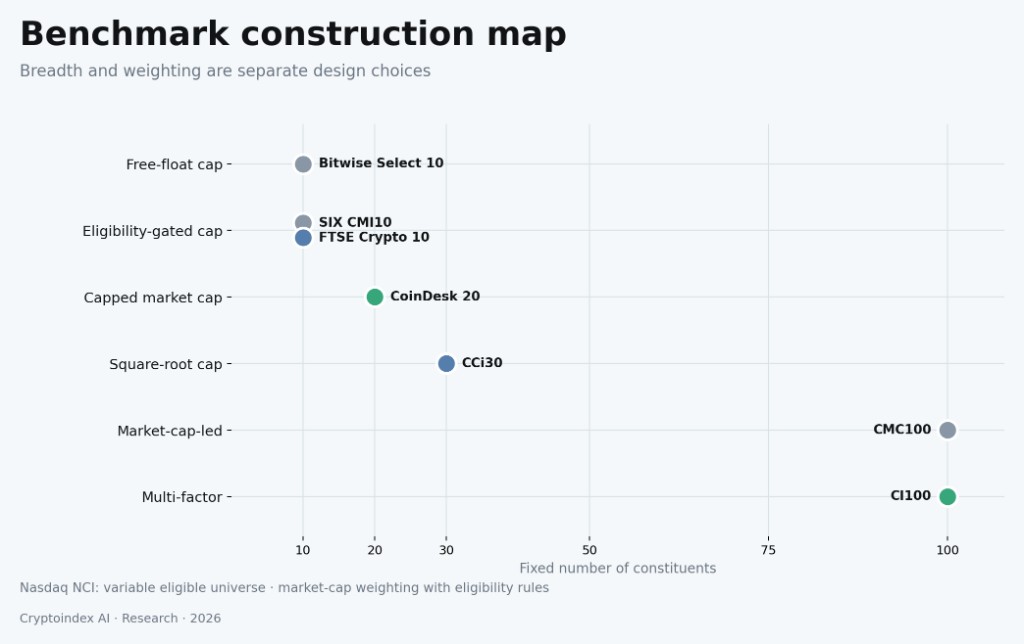
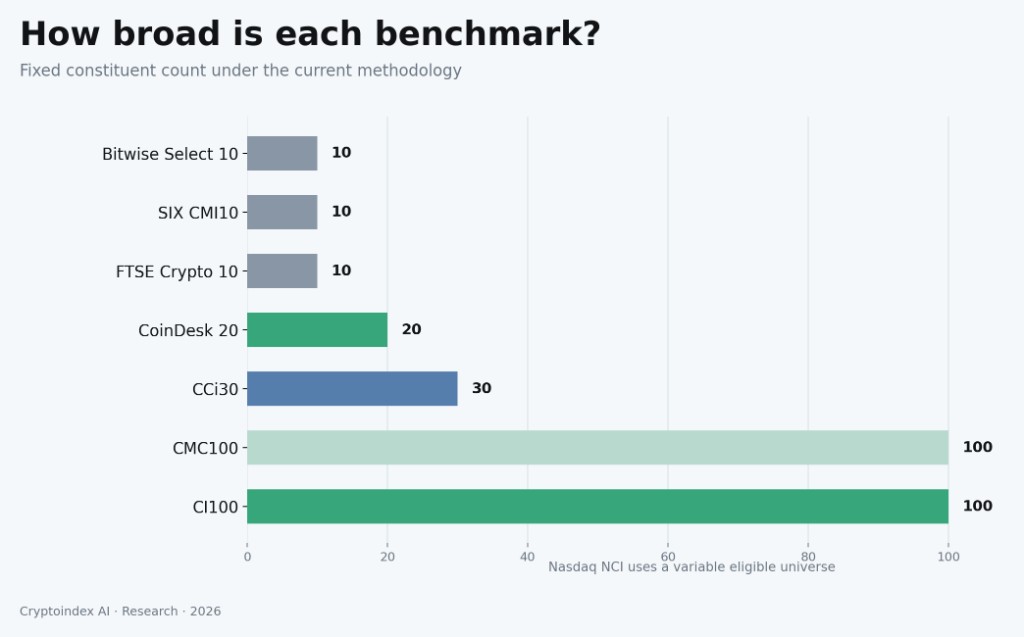
The table shows why constituent count is a weak shortcut. CoinDesk 20 and CCi30 are materially less concentrated than a conventional top-100 cap-weighted index, despite holding fewer names. Weighting determines whether smaller constituents can affect the result.
How we compared the indexes
The report uses six criteria. They are intentionally methodological rather than performance-based.
1. Market representation. Does the universe capture the segment named by the index, or do eligibility rules narrow it into something else?
2. Concentration control. How much of the final reading is driven by Bitcoin and Ether? Caps, square-root weighting, factor weighting and exclusions produce different answers.
3. Replicability. Could a fund follow the rules without excessive turnover, unreliable prices or impossible fills?
4. Pricing quality. Does the provider aggregate vetted trading venues, manage outliers and publish a robust reference price?
5. Governance and transparency. Are the rules, review schedule and decision-making process published clearly enough for an external analyst to reproduce the logic?
6. Usefulness. What question does the benchmark answer better than its peers?
No index receives points for a higher historical return. Backtests have different start dates, live histories differ in length, and every weighting rule is rewarded by a different market regime. Ranking methodologies by whichever one performed best last year is outcome chasing disguised as analysis.
1. CoinDesk 20: the strongest all-round tradable benchmark
The CoinDesk 20 tracks twenty large and liquid digital assets and was designed for implementation through investment and trading products. The methodology uses market capitalisation but caps larger constituents, with the largest limited to 30% and other constituents limited to 20% at rebalance.
That cap is the central design choice. Without it, a twenty-asset index would still be dominated by Bitcoin and Ether. With it, the remaining constituents receive enough weight to influence performance. The basket becomes meaningfully different from a two-asset proxy rather than merely a longer list of holdings.
CoinDesk also uses liquidity screens and a buffer around the lower inclusion ranks. Incumbents near the cutoff do not automatically leave whenever a challenger briefly overtakes them. That reduces turnover and makes the index more practical for products that must trade every addition and deletion.
What it does best: liquid broad-market exposure with explicit concentration control.
Main trade-off: a hard cap is enforced at rebalance, not continuously. Strong relative performance can push a live weight above its stated cap before the next reset. The index also represents an investable subset of crypto rather than every economically relevant asset.
Best for: investors, product issuers and analysts who want one benchmark that is broader than Bitcoin and still realistic to replicate.
2. Nasdaq CME Crypto Index: the institutional benchmark
The Nasdaq CME Crypto Index is designed to measure a significant and investable portion of the digital asset market. Its identity comes from the eligibility process as much as from the weighting formula. Assets must pass trading, custody and pricing requirements before market capitalisation becomes relevant.
Nasdaq describes the index as dynamic, broadly representative and readily trackable. The current methodology uses formal governance through Nasdaq's index management structure and relies on institutional pricing inputs. Those requirements can exclude an asset that is economically large but difficult to price, custody or trade through the approved market infrastructure.
This makes NCI less useful as a pure census of crypto and more useful as an institutional opportunity set. The distinction is important. An index can accurately measure the assets a regulated product can hold without measuring every asset crypto traders consider important.
What it does best: combines institutional governance, pricing discipline and product suitability.
Main trade-off: eligibility gates can create a gap between the index and the unconstrained crypto market. Market-cap weighting can still leave the basket concentrated in its largest constituents.
Best for: institutions, advisers and anyone comparing index-linked products built on regulated market infrastructure. The live series is on the Nasdaq Crypto Index page.
3. CCi30: the most elegant concentration solution
The CCi30 selects thirty large cryptocurrencies by adjusted market capitalisation, excludes stablecoins and weights constituents according to the square root of adjusted market cap. Its published history extends to 2015, and the methodology was developed as a rules-based measurement of the broader crypto market.
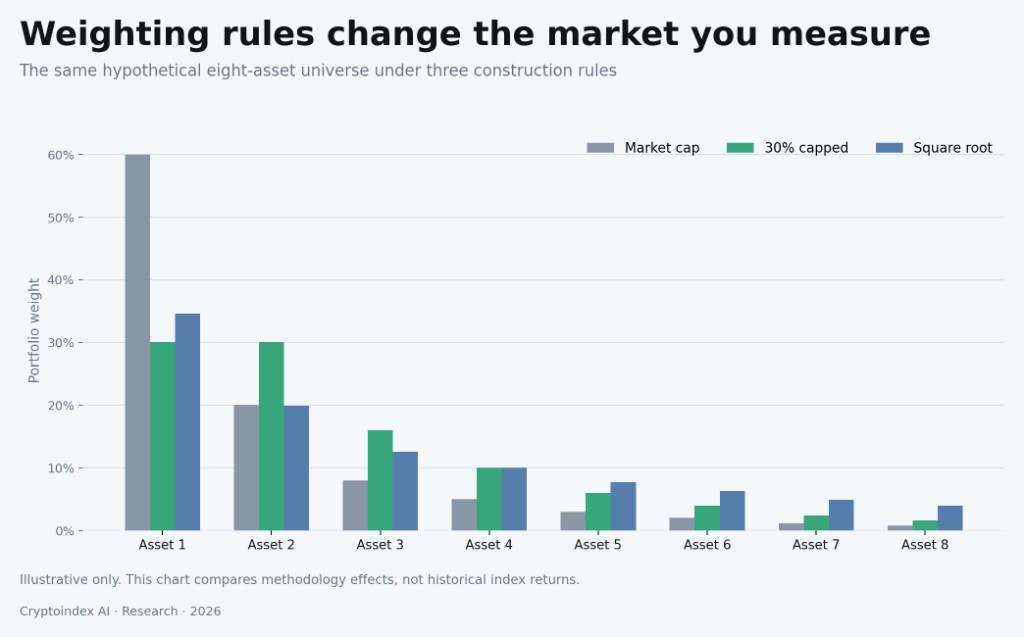
Square-root weighting is the feature that separates CCi30 from conventional market-cap benchmarks. If one asset is one hundred times larger than another, raw market-cap weighting gives it one hundred times the weight. Square-root weighting reduces that relationship to ten times. Large assets still matter more, but their dominance is compressed smoothly.
This avoids the cliff created by a hard cap. There is no threshold where one asset suddenly stops receiving weight while another continues. It also avoids equal weighting, which can assign too much influence to smaller and less liquid constituents.
CCi30 selects constituents quarterly and recalculates weights monthly. The provider publishes historical compositions, daily values and replication tools, giving researchers an unusually long and inspectable dataset for a crypto-native benchmark.
What it does best: measures a broad crypto market while reducing concentration through a continuous mathematical rule.
Main trade-off: square-root weighting is a deliberate departure from the economic size of the market. It improves breadth but no longer answers the simple question, "How is total market value distributed?" Replicating thirty changing assets is also more operationally demanding than following a top-10 basket.
Best for: research, allocation analysis and investors who want broad exposure without a hard constituent cap. The live series is on the CCi30 page.
CoinDesk 20 vs CCi30
This is the most useful head-to-head comparison in the report because both indexes address the same problem differently.
| Question | CoinDesk 20 | CCi30 |
|---|---|---|
| How is concentration reduced? | Hard caps at rebalance | Square-root market-cap weighting |
| Number of assets | 20 | 30 |
| Main priority | Tradability and product implementation | Broad market measurement |
| Turnover control | Eligibility screens and buffers | Scheduled selection and monthly reweighting |
| Best use | Index-linked products | Research and concentration-aware benchmarking |
CoinDesk 20 is the stronger choice when the benchmark must underwrite a scalable product. CCi30 is the more intellectually interesting measure of the market because its weighting rule preserves rank while reducing domination by the largest assets. Neither is universally better. They optimise for different jobs.
4. Bitwise Select 10: the fund-linked large-cap basket
The Bitwise Select 10 Large Cap Crypto Index captures up to ten leading eligible crypto assets using free-float-adjusted market capitalisation. The associated BITW structure makes it one of the clearest examples of the difference between an index and a product that tracks it.
Free-float adjustment removes supply that is not realistically available to the market. Monthly reconstitution and buffer rules aim to keep the basket current without forcing unnecessary swaps. These are practical decisions made for a portfolio that must buy, custody and sell its holdings.
The cost is concentration. Market-cap weighting naturally places most of the exposure in Bitcoin and Ether. Ten constituents do not create ten meaningful return drivers when the bottom assets receive fractions of the portfolio.
What it does best: provides a transparent benchmark for a real large-cap investment product.
Main trade-off: behaves closer to a Bitcoin-and-Ether portfolio with small satellite positions than to an evenly diversified crypto basket.
Best for: studying investable large-cap exposure and the tracking relationship between a fund and its named benchmark.
5. SIX Crypto Market Index 10: compliance expressed as methodology
The SIX Crypto Market Index 10 measures up to ten of the largest and most liquid eligible crypto assets. It is published by the operator of the Swiss and Spanish stock exchanges and is designed as an investable benchmark.
Its most distinctive features are the eligibility requirements surrounding trading venues, operational history, custody and asset characteristics. These rules are not secondary administration. They define the market that the index believes regulated products can access.
What it does best: translates European exchange and compliance constraints into a transparent large-cap universe.
Main trade-off: like other top-10 cap-weighted benchmarks, it remains concentrated and may omit important assets that fail infrastructure or eligibility tests.
Best for: European institutional comparison, structured products and regulated-market analysis.
6. FTSE Crypto 10 Select: a traditional index framework applied to crypto
The FTSE Crypto 10 Select Index tracks ten large eligible digital assets using the broader FTSE Digital Asset Index Series framework. FTSE Russell applies asset and exchange screening, liquidity tests, vetted reference pricing and quarterly review.
The appeal is institutional familiarity. The governance model resembles the way traditional index providers define equity or bond universes, while Digital Asset Research contributes crypto-specific market vetting. The index family also includes ex-Bitcoin variants, allowing investors to separate large-cap crypto exposure from the market's dominant asset.
What it does best: provides a conventional index-provider framework with crypto-specific data controls.
Main trade-off: a top-10 market-cap universe remains narrow and concentrated; institutional cleanliness does not automatically produce diversification.
Best for: advisers and product users who value established benchmark governance and index-linked implementation.
7. CoinMarketCap 100: breadth of coverage, not necessarily exposure
The CoinMarketCap 100 offers a familiar broad-market display built around one hundred crypto assets. Its strength is accessibility: CoinMarketCap is widely used, the index is easy to discover, and current values are available through an API.
But one hundred names can create a misleading impression of diversification. Under market-cap-led weighting, the smallest constituents may contribute very little to daily performance. The index is useful as a broad dashboard reading, but analysts should check live concentration before treating it as an alternative to a top-10 benchmark.
What it does best: accessible, high-coverage market display and data distribution.
Main trade-off: constituent breadth may exceed exposure breadth. It is a display index, not something an investor buys directly.
Best for: dashboards, APIs and a quick reading of the broader listed crypto universe.
8. CI100: a multi-factor market reading
CI100 tracks one hundred assets using four factors: market size, trading volume, liquidity and volatility. The purpose of the additional factors is to avoid giving an asset full credit for a large nominal market capitalisation when its tradability cannot support that valuation.
This changes the question. A pure cap-weighted index asks where market value is concentrated. CI100 asks which assets combine size with observable trading quality and relative stability. The approach can reduce concentration without imposing a single hard cap.
Continuous refresh keeps the display close to current market conditions, but it creates a clear limitation: a live fund could not trade every change without incurring costs. CI100 is therefore best understood as a measurement and research index rather than a frictionless investable portfolio.
What it does best: combines breadth with liquidity and trading-quality information.
Main trade-off: less mechanically replicable than quarterly or monthly product benchmarks.
Best for: live market monitoring, cross-sectional research and comparison with conventional cap-weighted indexes.
CoinDesk 20 vs Nasdaq NCI
The two benchmarks are frequently grouped together because both support institutional products, but their emphasis differs.
CoinDesk 20 begins with a fixed, recognisable twenty-asset structure and actively controls concentration through caps. Nasdaq NCI begins with institutional eligibility and pricing infrastructure, allowing the qualifying universe to determine the basket. CoinDesk is more explicit about the shape of the finished portfolio; Nasdaq is more explicit about the quality and investability of the route into it.
For broad exposure with reduced Bitcoin concentration, CoinDesk 20 is the clearer answer. For benchmarking a product inside institutional governance and pricing constraints, Nasdaq NCI has the stronger case.
The rankings: best crypto indexes by use case
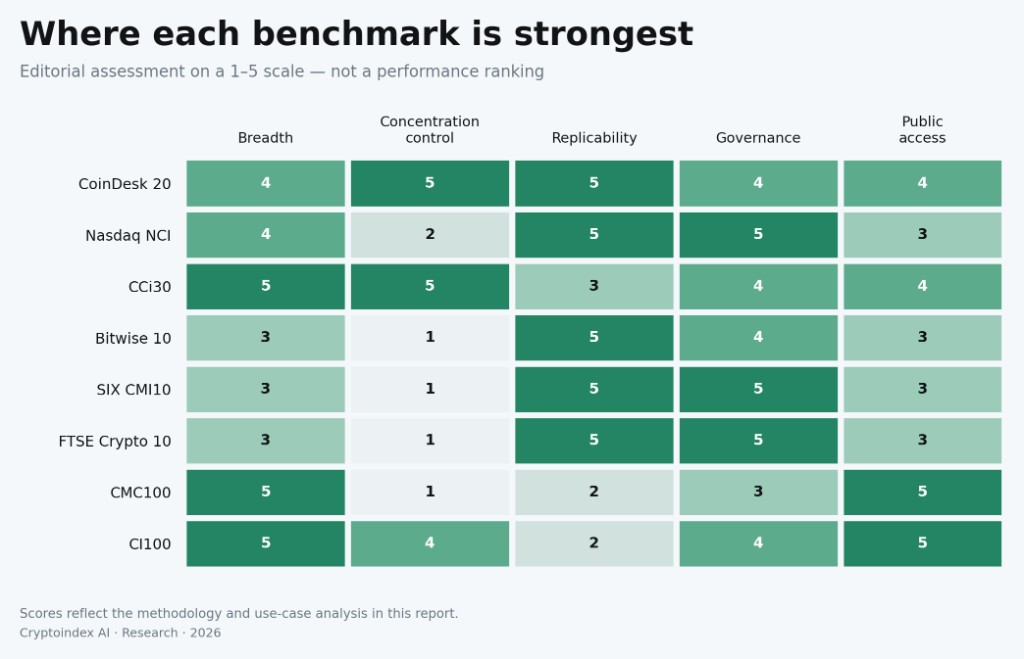
Best all-round broad-market benchmark: CoinDesk 20
CoinDesk 20 offers the best balance of breadth, liquidity, concentration control and product usability. It is not the broadest by number of assets, but every constituent has a better chance of affecting the result.
Best institutional benchmark: Nasdaq CME Crypto Index
Nasdaq NCI wins on governance, eligibility discipline and suitability for regulated products. It measures an institutionally accessible market rather than the entire unconstrained crypto universe.
Best concentration-aware market index: CCi30
CCi30's square-root weighting is the most coherent alternative to both raw market cap and hard caps. It keeps economic size relevant while preventing the largest asset from dominating in direct proportion to its market value.
Best fund-linked large-cap index: Bitwise Select 10
Bitwise Select 10 is the most useful for studying how index rules translate into an operating portfolio. Its limitation is also visible: investability and market-cap fidelity produce high concentration.
Best European exchange benchmark: SIX CMI10
SIX CMI10 stands out for formal exchange governance and compliance-oriented eligibility rules.
Best accessible broad display: CoinMarketCap 100
CMC100 is easy to find, distribute and integrate, although readers should not confuse one hundred constituents with one hundred meaningful exposures.
Best multi-factor display: CI100
CI100 is the strongest option when the goal is to measure more than nominal market value and incorporate observable trading quality.
What none of these rankings tells you
The rankings do not identify the index that will deliver the highest return. No methodology can do that consistently, and a benchmark should not be selected by backtesting until the preferred answer appears.
A top-10 market-cap index will usually lead when Bitcoin and the largest assets outperform. A capped or square-root-weighted index will look stronger when the rally broadens. An ex-Bitcoin basket will dominate during an altcoin cycle and lag badly during a flight to quality. Those outcomes describe the market regime, not the intellectual quality of the rules.
The same caution applies to live and backtested histories. An index launched recently may publish a long simulated record based on today's methodology. That history is useful for understanding behaviour, but it was constructed with knowledge of the assets and market structure that survived. It is not equivalent to a live series that existed through those decisions in real time.
How to choose a crypto index
Start with the question rather than the provider.
If you want the investable broad market: choose a liquid, capped benchmark such as CoinDesk 20 or an institutionally screened benchmark such as Nasdaq NCI.
If you want a less concentrated market reading: use CCi30 or a transparent factor-weighted index and compare it against a cap-weighted benchmark.
If you want large-cap fund exposure: study the exact benchmark named by the fund, its live holdings, fees and tracking difference. Do not replace it with a similarly named index.
If you want the altcoin market: use an ex-Bitcoin index. Removing Bitcoin answers the question more cleanly than trying to infer altcoin behaviour from a broad basket dominated by Bitcoin.
If you want a market dashboard: broad display indexes such as CMC100 and CI100 can be useful, but their numbers are not portfolios and do not include trading costs.
Before relying on any index, check five items: the eligible universe, the weighting rule, the current largest weight, the rebalance schedule and whether the published history is live or simulated.
Frequently asked questions
What is the best crypto index in 2026?
There is no universal winner. CoinDesk 20 is the strongest all-round liquid broad-market benchmark; Nasdaq CME Crypto Index is strongest for institutional governance; CCi30 is strongest for concentration-aware market measurement; Bitwise Select 10 is most relevant for a fund-linked large-cap basket.
What is the difference between CoinDesk 20 and Nasdaq Crypto Index?
CoinDesk 20 uses a fixed twenty-asset structure with explicit constituent caps designed to reduce concentration. Nasdaq NCI uses institutional eligibility, custody, exchange and pricing requirements to define a dynamic investable universe. CoinDesk emphasises portfolio shape; Nasdaq emphasises institutional accessibility.
Is CCi30 better than CoinDesk 20?
CCi30 is better for research into a broad market with smoothly reduced concentration. CoinDesk 20 is better when liquidity, licensing and product replication are the priority. CCi30 uses square-root weighting; CoinDesk 20 uses hard caps.
Can I invest directly in a crypto index?
No. An index is a calculation. Investors need a fund, ETF, ETP, derivative or separately managed portfolio that follows the index. Many popular crypto indexes are display benchmarks with no directly purchasable product.
Does a 100-asset crypto index provide more diversification than a 10-asset index?
Not automatically. If both are market-cap weighted, the additional ninety assets may receive only a small combined weight. Diversification depends on weight distribution, not the number of lines in the constituent file.
Which crypto index excludes Bitcoin?
Several providers publish ex-Bitcoin variants, including FTSE Crypto 10 Select ex Bitcoin and specialist altcoin indexes. These are designed to measure the market outside Bitcoin rather than dilute Bitcoin through caps.
Conclusion
The crypto index market has matured into distinct layers. CoinDesk 20 is built for liquid broad-market products. Nasdaq NCI and SIX CMI10 translate institutional access rules into benchmark universes. CCi30 offers a concentration-aware measurement of the market. Bitwise Select 10 shows how a benchmark operates inside a real fund structure. CoinMarketCap 100 maximises accessible coverage, while CI100 adds trading quality to the weighting process.
The label on the index is less important than the decision embedded in its methodology. A cap, a square root, an eligibility gate or an exclusion can change the exposure more than adding another fifty constituents.
The best crypto index is therefore the one whose rules answer the question being asked. Everything else is a comparison of numbers that were never intended to measure the same thing. Live readings for the benchmarks tracked here are on the indices page.
Methodologies were reviewed on 6 October 2026 and may change. Cryptoindex.ai is not affiliated with the providers discussed. This report is informational and is not investment advice.