Sector Indices
Crypto Sector Indices: How to Track a Narrative With Numbers
Guides · Sep 29, 2026
GuidesIndicesSectors
A single token chart cannot tell you if a narrative is real. Sector indices measure the group — how they are built, which weighting fits which theme, and how to use them.
Someone in your feed says AI tokens are running. You open a chart for the biggest AI token, see a green candle, and now you have a feeling rather than a fact.
The question you actually wanted answered is different: is the sector moving, or is one name carrying the story? A single token cannot tell you. A sector index can, because it measures the group rather than its loudest member.
This guide covers how thematic crypto indices are built, what each major sector index is really measuring, where the definitions get slippery, and how to use them without fooling yourself.
What a sector index is
A sector index is a rules-based basket of tokens that belong to one theme, published as a single continuously updated number.
The mechanics are the same as any index. A universe defines who is eligible, a weighting scheme decides how much each constituent counts, and a rebalance rule decides how often the basket changes. The only difference is that the universe is a theme rather than a size ranking.
That difference is larger than it sounds. A broad index like CI100 draws from an objective list: the top hundred by size and liquidity. A sector index draws from a judgment call. Somebody had to decide what counts as an AI token, and that decision is the product.
Why broad indices cannot answer sector questions
Bitcoin dominance has run near 57 to 59% through 2026. Any cap-weighted broad index in a market shaped like that is mostly bitcoin with decoration.
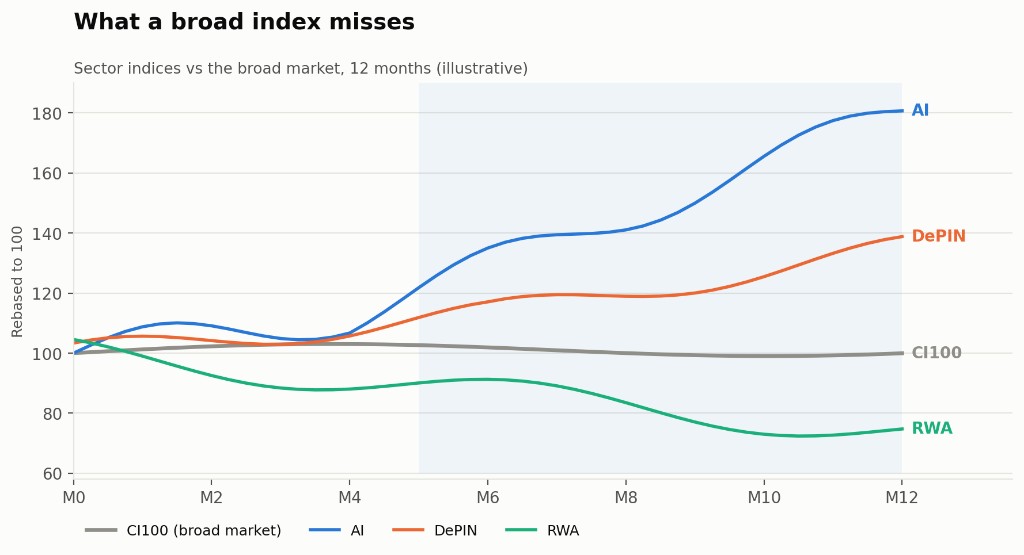
Which means a broad index is structurally blind to the thing most traders care about day to day. If AI tokens collectively rise 20% while they represent a small slice of total market cap, the broad index barely twitches. The rotation happened. The benchmark did not see it.
This is the gap sector indices fill. Broad indices tell you what the market did. Sector indices tell you where the money went.
The sectors worth tracking
Each theme has a different internal structure, and that structure decides how its index should be built.
AI tokens
The largest thematic sector by attention and one of the messiest by definition. It covers decentralized compute networks, inference marketplaces, agent frameworks, data protocols and several projects whose connection to AI is mostly a rebrand.
The practical problem: the sector's composition changes faster than any other, because the narrative attracts new entrants continuously. An AI index built two years ago and an AI index built today may share very few names.
Cryptoindex publishes CI AI Cryptoindex, which takes the most liquid AI names and weights them by market cap, excluding microcaps. Market-cap weighting here is a deliberate choice: in AI the size hierarchy is itself information, because the largest projects are the ones with real infrastructure behind them.
DePIN
Decentralized physical infrastructure. Wireless networks, storage, compute, mapping, energy. What separates DePIN from most crypto themes is that these projects have physical deployments and measurable off-chain usage, which makes the sector's fundamentals unusually checkable.
DePIN Cryptoindex covers the most liquid DePIN names with market-cap weighting and no microcaps. The microcap exclusion matters more here than elsewhere: DePIN has a long tail of projects with a few nodes and a thin order book, and including them adds noise rather than coverage.
Real-world assets
Tokenized treasuries, private credit, commodities. RWA gets grouped with DeFi in most taxonomies and behaves nothing like it.
A tokenized treasury is a yield instrument whose price barely moves. A DeFi protocol token is a high-beta equity-like asset. Put them in one basket and you get a number that describes neither. CI-RWA keeps the sector separate and weights it equally, so a single large issuer cannot dominate the reading.
DeFi
The oldest thematic sector and the one with the clearest boundaries. Lending, exchanges, derivatives, liquid staking.
CI-DeFi uses equal weighting. The reasoning is structural: DeFi has two or three tokens large enough to swallow a cap-weighted basket, and an index dominated by them would tell you about those protocols rather than about DeFi.
The narrower sleeves
Beyond the big four, Cryptoindex publishes indices for gaming, privacy coins, perpetual DEX tokens, prediction markets, tokenized stocks and pre-IPO exposure.
Two of those deserve a note. Privacy coins move on regulatory news rather than technology cycles, which makes them close to uncorrelated with everything else in crypto. Most broad benchmarks exclude them entirely, so the sector has no representation in mainstream data at all. Perpetual DEX tokens have become a genuine sector rather than a niche as on-chain derivatives volume has grown, and they behave differently from spot-focused DeFi.
The full list is on the indices page.
Equal weight or market cap: how to tell which a sector needs
This is the decision that determines whether a sector index is useful, and there is a simple test.
Ask whether the sector's size hierarchy is information or noise.
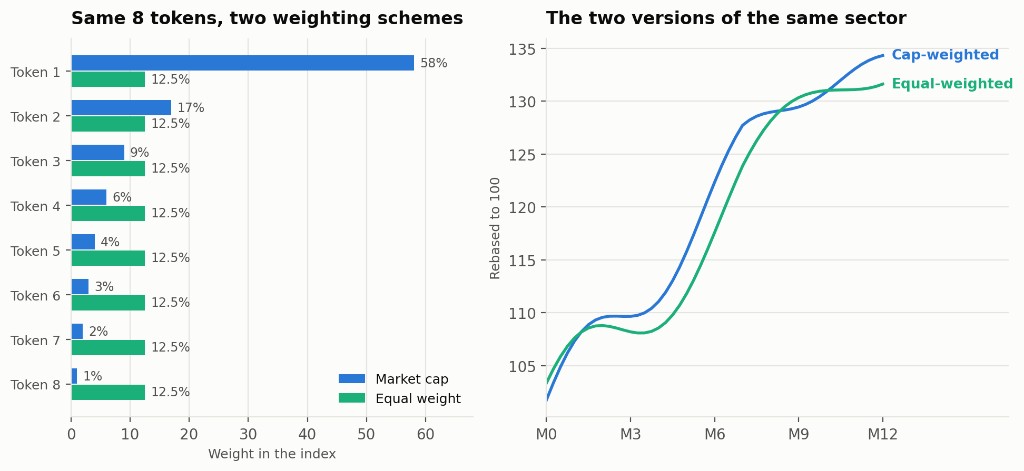
In AI and DePIN, the largest projects are largest because they have real networks, real usage and real capital behind them. Size carries meaning, so market-cap weighting is appropriate.
In DeFi and RWA, the largest name is often largest for historical reasons, and the sector's health is better described by how the group as a whole is doing. Equal weighting answers that question.
The failure mode is using the wrong one and not noticing. A cap-weighted DeFi index that is 60% one token is a single-token chart wearing a sector label. You would be surprised how many sector products work exactly that way.
The definition problem nobody solves cleanly
Every sector index has a boundary, and every boundary is arguable.
Is a general-purpose layer 1 that hosts AI applications an AI token? Is a stablecoin issuer an RWA project? Does a gaming studio token belong in gaming or in entertainment? When a project pivots, does the index move it, and how quickly?
There is no correct answer. What matters is that three things are true:
The boundary is published. You can read what the index considers eligible.
The boundary is applied consistently. Not loosened when a hot token does not quite fit.
The boundary is stable enough to compare across time. If the definition changes every quarter, the historical series is measuring several different things wearing one name.
Most sector indices, including the CI ones, inherit their category definitions from an upstream data provider's taxonomy. That is a reasonable approach and it comes with a consequence worth knowing: when the provider reclassifies a token, index composition changes with it, and nobody announces that.
When you use a sector index, open its constituent list once. Not to audit it, but to know what you are actually tracking. Ten seconds of looking prevents a lot of confused analysis later.
Four ways to actually use them
1. Test whether a narrative is real
The core use. A sector index answers the question a single chart cannot: is the group moving, or is one name carrying it?
The quick version: compare the sector index against its largest constituent over the same window. If the index closely tracks that one token, the narrative is one project's story. If the index moves while the leader is flat, the move is broad and more likely to be a genuine rotation.
2. Find rotation before it is obvious
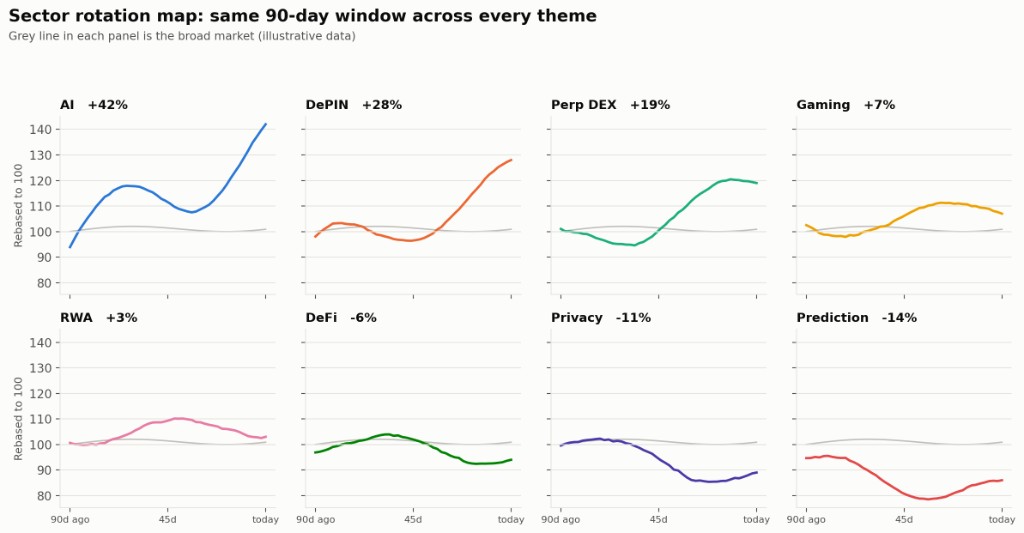
Put several sector indices on the same window and watch the spreads between them.
Capital moves between themes in sequence, and the spreads widen before the narrative reaches headlines. A sector that starts outperforming while the broad market is flat is showing you where money is going, several weeks before someone writes a thread about it.
3. Size a thematic position honestly
If you hold four AI tokens, you do not have a diversified AI position. You have four correlated bets on one narrative. The sector index shows you how correlated they actually are: if your basket tracks the index almost exactly, the diversification is imaginary, and your real risk is the theme rather than the picks.
4. Separate sector risk from market risk
When your thematic position drops 15%, the useful question is whether the sector dropped or the market dropped.
Compare the sector index with a broad index like CI100 and an ex-bitcoin index like CI-Alts. If everything fell together, you experienced market risk. If the sector fell while the broad market held, the thesis is what is being repriced. Those two situations call for different responses, and the difference is invisible without benchmarks.
Limits worth knowing before you rely on one
Sector indices are not investable. The CI sector indices are display indices: published series with open formulas, not funds. If you want exposure, you are buying the constituents yourself or finding a product elsewhere.
Thin sectors move on thin volume. A sector with eight constituents and modest liquidity can post large index moves on trades that would not register in a broad benchmark. Check the constituent count before reading much into a big number.
Category definitions come from upstream. Covered above. Reclassification changes composition quietly.
Short history. Most thematic sectors in crypto are a few years old at best. Any statistical claim built on that sample carries wide error bars.
Narrative sectors can die. A sector index will faithfully track a theme all the way into irrelevance. The index is not making a judgment about whether the theme has a future.
Building your own sector index
Published sector indices encode someone else's boundary. If you disagree with it, and on thematic definitions most active traders eventually do, you can define your own.
Cryptoindex Pro is a studio for exactly that. You pick the constituents, which is where your definition of the sector actually lives, choose equal, market-cap or custom weights, set a rebalance rule, and see how the basket would have behaved historically. Then you compare it against bitcoin, ether or the CI benchmarks to see whether your version of the sector adds anything.
The discipline is the point. "RWA is undervalued" is a feeling until you name the twelve tokens you mean, weight them, and produce a series someone can check.
Two standard cautions apply to any backtest. Historical simulations ignore trading costs, and they are built by someone who already knows how the story ended. Treat a backtest as a description of how a rule behaves, not as a forecast.
Frequently asked questions
What is a crypto sector index?
A rules-based basket of tokens belonging to one theme, such as AI or DeFi, published as a single continuously updated number. It shows how the group is performing rather than how any individual token is doing.
How are sector indices different from broad crypto indices?
A broad index draws from an objective ranking by size and liquidity and is usually dominated by bitcoin and ether. A sector index draws from a thematic definition and shows where capital is rotating within the market.
Should sector indices be equal-weighted or market-cap-weighted?
It depends on whether the sector's size hierarchy carries information. In AI and DePIN, larger projects usually have more real infrastructure, so market-cap weighting fits. In DeFi and RWA, one or two names would dominate the basket, so equal weighting describes the sector better.
Can I invest in a crypto sector index?
Not directly in most cases. The CI sector indices are display indices rather than funds. Some sector products exist in the market, but coverage is thin compared with broad-market products.
Which sectors have indices available?
Cryptoindex publishes indices for AI, DePIN, DeFi, RWA, gaming, privacy, perpetual DEX tokens, prediction markets and tokenized equities, plus ecosystem indices for Solana and Base. All are on the indices page.
How often do sector indices change composition?
It varies by provider. The CI sector indices refresh continuously from the underlying category data rather than locking composition for a month or quarter.
The short version
A sector index converts a narrative into something checkable. That is its entire value, and it is a large one in a market that runs on narratives.
Use them to test whether a story is a group move or a single name. Watch several at once to see rotation before it shows up in headlines. Read your own thematic basket against the relevant index to find out whether your diversification is real. And check the constituent list once, so you know what you are actually measuring.
Live sector and ecosystem indices, with formulas published for each, are on the Cryptoindex indices page.
Cryptoindex.ai publishes display indices for informational purposes. They are not funds, licensed benchmarks or investable products. Nothing here is investment advice.