Guides · Oct 5, 2026
Comparing Crypto Indices: What Actually Separates Them
GuidesIndicesComparison
Ten large caps and a hundred-asset index are not competitors. Compare universe, weighting and bitcoin concentration, not historical return.
Most crypto index comparisons rank benchmarks by return and declare a winner. That comparison is worthless, and it is worth explaining why before anything else.
An index of ten large caps and an index of a hundred assets are not competitors. They are measuring different markets. Saying one "beat" the other is like saying a thermometer beat a barometer. In a large-cap-led quarter the ten-asset index wins; in a broad rally the hundred-asset index wins; neither outcome tells you anything about the quality of the construction.
What is worth comparing is how they are built, because that determines what each one is useful for. This guide puts the major benchmarks side by side on the five dimensions that actually differentiate them, and then answers the practical question: which one should you be reading?
The five dimensions that matter
Universe. How many assets, selected how. A fixed count (top 10, top 20) behaves differently from a floating count driven by eligibility thresholds.
Weighting. Market cap, capped, equal, square root, or a multi-factor blend. This is the single biggest driver of how an index behaves.
Concentration. The practical consequence of weighting: how much of the index is bitcoin. This number predicts the index's behaviour better than anything else on the list.
Maintenance. How often the composition changes, and what friction rules slow down unnecessary churn.
What it is. A display index, a licensed benchmark with a formal administrator, or something with a fund attached. Three different objects, as covered in what is a crypto index.
Note what is not on that list. Historical return is not a dimension of comparison, it is an output of the other five interacting with whatever the market did.
The table
| Index | Assets | Weighting | Cap on largest | Reconstitution | Category |
|---|---|---|---|---|---|
| Bitwise 10 Large Cap | 10 | Free-float market cap | None | Monthly, last business day | Benchmark with fund (BITW) |
| SIX CMI10 | 10 | Market cap | Per methodology | Per SIX rulebook | Exchange-published index |
| CI10 Blue Chip | 10 | Factor blend, large caps only | Per methodology | Continuous | Display index |
| CoinDesk 20 | 20 | Capped market cap | 30% largest, 20% others | Quarterly | Licensed benchmark |
| CoinMarketCap CMC20 | 20 | Market cap | Per methodology | Per methodology | Display index |
| CI-Alts | 20, bitcoin excluded | Factor blend | Per methodology | Continuous | Display index |
| CCi30 | 30 | Square root of market cap | None (implicit via sqrt) | Quarterly | Display index, academic origin |
| CoinMarketCap CMC100 | 100 | Market cap | Per methodology | Per methodology | Display index |
| CI100 | 100 | Four factors: cap, volume, liquidity, volatility | Per methodology | Continuous | Display index |
| Nasdaq Crypto Index | Variable | Market cap, eligibility-gated | Per methodology | Quarterly | Licensed benchmark family |
Read down the "weighting" column rather than the "assets" column. Two indices with the same constituent count and different weighting rules will diverge far more than two indices with different counts and the same rule.
The "reconstitution" column is worth a second look too, because it splits the field cleanly. Every licensed benchmark on this list runs on a calendar, monthly or quarterly, because products are built on it and products need a predictable trading date. The three CI indices refresh continuously instead. That buys accuracy and costs replicability, and it is the right trade for an index whose job is to describe rather than to underwrite, which is the distinction the rest of this guide keeps returning to.
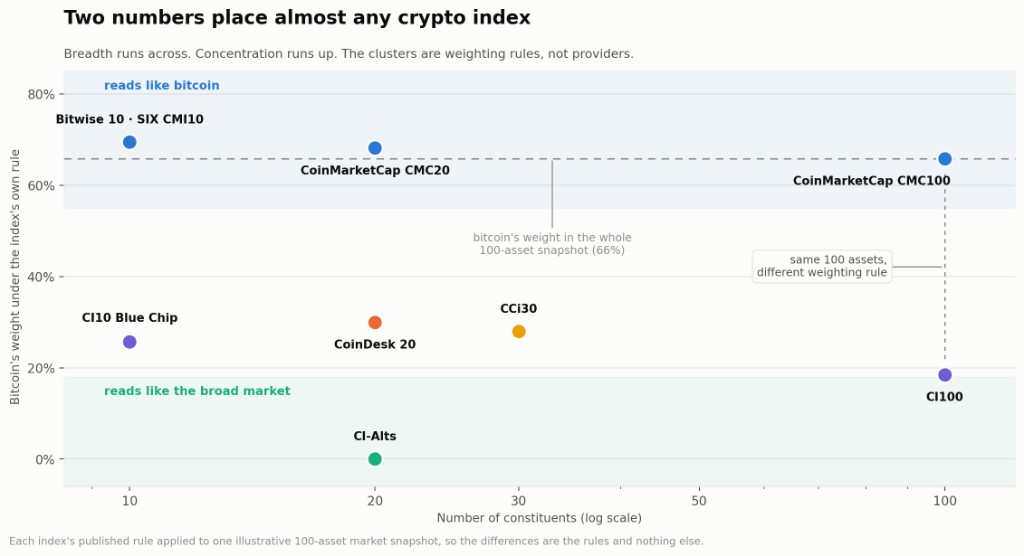
Concentration is the number to look at first
If you only check one thing about an index, check how much of it is bitcoin.
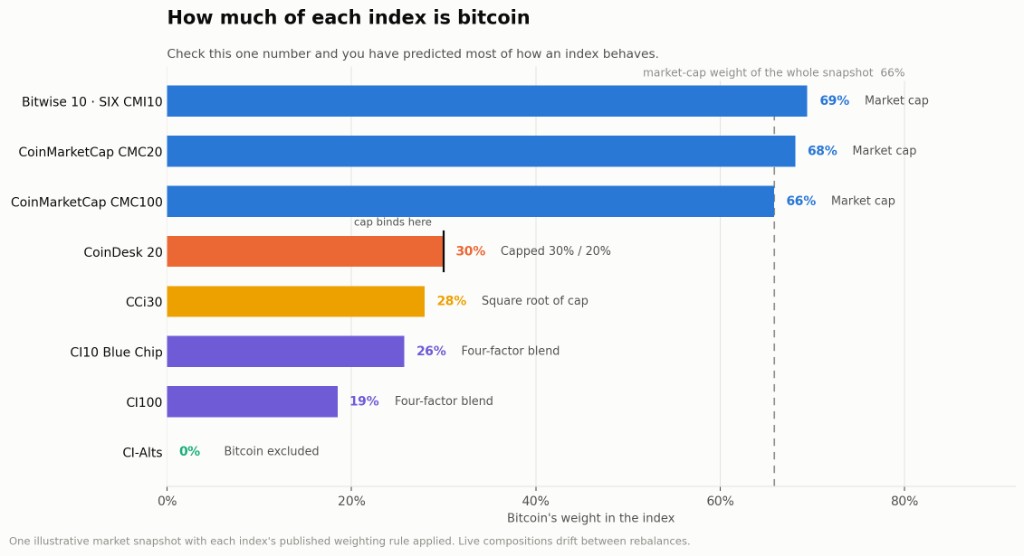
The mechanism is simple. Bitcoin is a large share of total crypto market capitalization, which means any market-cap-weighted index inherits that concentration. A ten-asset cap-weighted index is roughly three-quarters bitcoin. Its chart and bitcoin's chart are close to the same picture.
Every design choice that pulls an index away from pure market cap is, at bottom, a decision about how much bitcoin to allow.
A cap does it bluntly. The CoinDesk 20's 30% ceiling is the single most consequential line in its methodology. Without the cap it would be a bitcoin index with nineteen passengers; with it, the other nineteen assets get enough weight to actually move the number.
Square root does it gradually. CCi30 compresses the gap between large and small without flattening it. Bitcoin stays the biggest holding, just not by the margin its raw size would command.
Factor blending does it indirectly. CI100 mixes size with volume, liquidity and volatility, so concentration falls as a side effect of the other three factors rather than as a stated cap.
Exclusion does it absolutely. CI-Alts removes bitcoin entirely. That is not a tilt, it is a different question: what is the rest of the market doing when the largest asset is not in the frame.
One subtlety worth knowing. A cap is normally enforced at rebalance, not continuously. If bitcoin rallies hard in the first weeks of a quarter, a 30%-capped index may be running at 35% for a month. The headline description and the live composition can differ meaningfully, which is fully disclosed and widely misunderstood.
Head to head: the three pairs people confuse
CoinDesk 20 vs CCi30
Both are broad, both are rules-based, both are respected. They solve the concentration problem differently and that is the whole comparison.
CoinDesk uses a hard cap with a buffer zone: ranks 1 to 15 are included automatically, ranks 16 to 25 form a zone where incumbents keep priority over newcomers. The result is a stable twenty-name list with an explicit ceiling.
CCi30 uses square-root weighting with thirty names and no explicit cap. The compression is smooth rather than binding, so there is no cliff at a particular weight and no quarterly snap back to a threshold.
Practical difference: the CoinDesk 20 is built to underwrite products, with the governance and licensing apparatus that implies. CCi30 came out of an academic project and reads as a market measurement. If you want a benchmark that something is listed against, CoinDesk. If you want a smooth broad-market reading, CCi30.
Bitwise 10 vs SIX CMI10
Two ten-asset large-cap indices, both market-cap weighted, and they are built for different worlds.
Bitwise 10 is the index behind a fund. Its methodology is written with replication in mind: free-float adjustment, a 10% margin rule sustained over five consecutive days before an incumbent is removed, monthly reconstitution and a provision for a same-day intraday rebalance if a weight condition breaks. The buffer exists because every swap costs real money in a real portfolio.
SIX CMI10 is an exchange-published index with eligibility gates that have nothing to do with price: constituent assets must trade on exchanges in FATF or Moneyval jurisdictions, with eighteen months of stable operation and a usable API, and assets themselves must not be anonymity-focused or pegged, and must have multi-signature custody available. Those screens are a compliance posture expressed as an index rule.
Practical difference: Bitwise tells you what a tradeable large-cap basket does. CMI10 tells you what a large-cap basket looks like once a regulated European exchange has filtered it.
CI100 vs CMC100
Two hundred-asset indices. Same universe size, and they measure almost opposite things.
CMC100 is market-cap weighted, so it inherits the market's own concentration: bitcoin takes roughly two thirds and the bottom half of the list rounds to nothing. Adding the ninety-first asset changes the number by an amount you cannot see on a chart.
CI100 blends four factors, size with trading volume, liquidity and volatility. Bitcoin's weight drops to a fraction of what pure market cap would give it, and the tail moves out of rounding-error territory into weights that actually register. An asset that is large but thinly traded ranks below one that is slightly smaller and trades properly, which is a different claim about what "important" means in a market.
Practical difference: CMC100 answers "where is the money." CI100 answers "where is the money that can actually move." On a day when a large illiquid token gaps on thin volume, the two will disagree, and the disagreement is the methodology talking.
A top-10 index vs a top-100 index
This is the comparison people make most often and understand least.
A cap-weighted top-100 index is not meaningfully broader than a cap-weighted top-10 index. The bottom fifty constituents may together account for a few percent of the weight. You added ninety names and almost no exposure.
Breadth comes from weighting, not from constituent count. An equal-weighted top-20 index is far more exposed to the mid-cap market than a cap-weighted top-100 index. If someone offers you "broader coverage" and the weighting is unchanged, you are being offered a longer list, not a different measurement.
Which one answers your question
| If you want to know | Read |
|---|---|
| What the crypto market did today | A broad index: CI100, CMC100, CCi30 |
| What large caps did | A top-10 index: Bitwise 10, SIX CMI10, CI10 |
| What the market did excluding bitcoin | CI-Alts, or a broad index compared against bitcoin |
| Whether a fund is tracking properly | The benchmark that fund names, nothing else |
| How concentrated the market has become | Two indices at once, broad against top-10, and watch the spread |
| What a theme is doing | A sector index, plus a broad index as the control |
That last row is the one people skip. A sector index on its own tells you whether the theme went up. A sector index next to a broad index tells you whether the theme was worth being in, which is the actual question.
Why return comparisons mislead
Three reasons, each sufficient on its own.
Different universes. A top-10 and a top-100 index are measuring different markets. Whichever segment led over your chosen window wins, and the window is arbitrary.
Different start dates and different history types. An index with a live record from 2018 and an index with a backtest from 2015 are not comparable evidence. A backtest is built by someone who already knows how the story ended, and it carries no trading costs. A live print carries neither advantage.
Different costs assumed, which is to say none. No index pays spreads, slippage or fees. An index that rebalances continuously posts returns that no portfolio could capture, because capturing them would require continuous trading. That is fine for a display index and it makes cross-index return tables meaningless as a ranking of quality.
The honest comparison is construction, not performance. Compare the rules, decide which rule answers your question, and use the chosen index's return as a benchmark rather than as a scoreboard entry.
When none of the ten fits
Ten indices sounds like a lot of coverage until you try to benchmark something specific. A portfolio that is large-cap infrastructure plus a DePIN sleeve has no published benchmark, and comparing it against a broad index mixes your allocation decision with your selection decision.
At that point the comparison you need does not exist yet and you have to build it.
Cryptoindex Pro lets you set a universe, choose a weighting rule, set a rebalance cadence and replay the result through history, then put it next to bitcoin, ether or the CI benchmarks. The useful discipline for a comparison specifically: build the same basket twice and change exactly one thing. Same assets, cap-weighted and equal-weighted. Same weights, monthly and quarterly. The gap between the two lines is that one decision, isolated, which is the cleanest way to understand what any of the rules in the table above are actually doing.
Standard backtest cautions apply. Historical simulations carry no trading costs and are assembled by someone who already knows how the story ended. Use them to understand how a rule behaves, not to forecast what it will earn.
Frequently asked questions
What is the best crypto index? There is no single best one. A top-10 index is best for large-cap exposure, a broad index for the whole market, an ex-bitcoin index for alt-market behaviour. Choosing is a matter of matching the universe and weighting to the question you are asking.
What is the difference between the CoinDesk 20 and CCi30? Both are broad and rules-based. CoinDesk 20 holds twenty assets with a hard 30% cap on the largest and a buffer zone at ranks 16 to 25. CCi30 holds thirty and weights them by the square root of market cap, which compresses concentration smoothly instead of capping it.
Which crypto index has the most assets? Among widely followed benchmarks, the hundred-asset indices such as CI100 and CMC100. More constituents does not mean more diversification unless the weighting scheme gives the smaller names real weight.
Can I compare crypto indices by their returns? Only if they share a universe and a weighting scheme, which almost none of them do. Different return numbers usually reflect different market segments rather than better or worse construction.
Which crypto indices can I actually invest in? Only those with a fund or product attached. Most published crypto indices are display indices with no investable vehicle. The index itself is never purchasable; a product tracking it may be.
How much of a crypto index is bitcoin? In a pure market-cap-weighted index, close to bitcoin's share of total market capitalization, which has run in the high fifties as a percentage of the market and higher once stablecoins are excluded. Capped, square-root and factor-weighted indices deliberately hold less.
The short version
Compare construction, not performance. Five dimensions do all the work: universe, weighting, concentration, maintenance, and whether the thing is a display index, a licensed benchmark or a fund.
Concentration is the shortcut. Check how much of the index is bitcoin and you will predict most of its behaviour before looking at a single price. Everything else in the methodology is, in one way or another, a decision about that number.
And constituent count is the least informative figure on the page. Ninety extra names at a tenth of a percent each change nothing. Weighting is what makes an index broad.
Live side-by-side construction details for every benchmark we track are on the indices page, where you can see the concentration figure above as a current number rather than an illustration. Full CI formulas, including the four-factor weighting and the continuous refresh rule, are published on the methodology page. And if nothing on the list measures what you are actually holding, build the benchmark you need.
Cryptoindex.ai publishes display indices for informational purposes. They are not funds, licensed benchmarks or investable products. Index details are summarised from publicly available methodology documents and may change; always check the provider's current rulebook. Nothing here is investment advice.