Index Studio
Build the Index You Actually Wanted to Buy
Guides · Sep 21, 2026
GuidesIndicesPro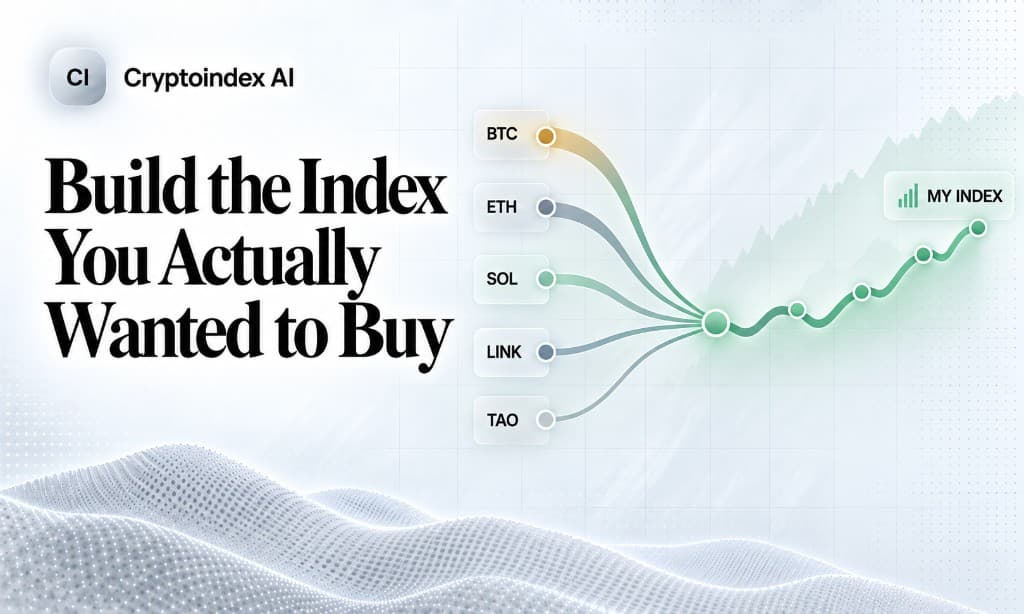

BITW and GDLC mostly accept bitcoin concentration. If that is not your answer, Cryptoindex Pro lets you state a different one as a live, checkable basket.
BITW holds ten crypto assets and bitcoin is around 77% of it. GDLC holds five and bitcoin is around 74%. Both are sensible products built by serious people, and both encode the same answer to the only question that really matters in index design: what do you do about the fact that one asset is most of this market?
Their answer is "mostly accept it." That is a legitimate answer. It is not the only one, and it may not be yours.
The problem until recently was that disagreeing with an index got you nowhere. You could write a post about how you would weight things differently. You could not produce a number, a chart, or anything anyone could check.
That is the gap Cryptoindex Pro fills. It is an index studio: pick the assets, set the weights, see what that basket would have done, put it next to bitcoin, publish it with your reasoning attached. Nothing is bought or sold, no wallet is connected, no orders are placed. It is analysis, and you can try it before you register.
Here is why you might want to, and how to do it without fooling yourself.
Three Reasons to Build One
To test a thesis instead of asserting it. "DePIN is undervalued" is a vibe. A six-asset DePIN basket with published weights, a drawdown figure and a line next to bitcoin is a claim. The second one can be wrong, which is exactly what makes it worth making.
To get a benchmark that actually matches what you hold. This is the underrated one. If your portfolio is 60% bitcoin, 20% ether and 20% spread across four alts, no published index measures you. Not CI100, not the CoinDesk 20, not BITW. When you check whether you are doing well, you are comparing yourself against a basket you do not own. Build your own allocation as an index and you finally have a yardstick that answers the right question.
To see what a weighting rule does before you trust it. Most people have never watched the same ten assets produce three different results under three different weighting schemes. It is a fast education, and it changes how you read every fund fact sheet afterwards.
The Four Decisions That Actually Matter
Before touching the interface, know what you are deciding. These four determine almost everything about how your index behaves.
1. The universe
Which assets are even candidates. This sounds trivial and it is where most of the thinking should go.
A sector thesis needs a defensible boundary. Is a token that does one AI thing and four other things an AI asset? Does a chain count as DePIN because a DePIN project runs on it? There is no correct answer, and picking one and stating it is most of what separates a real index from a list of things you like.
Published indexes make these calls too, they just make them in a methodology document nobody reads. The CoinDesk 5 excludes stablecoins, memecoins, gas tokens, privacy tokens, wrapped tokens and staked assets. That is six editorial decisions in one line.
2. The weights
Three options, and the gap between them is larger than the gap between most funds.
Equal weight gives every asset the same slice. Maximum breadth. Your tenth pick matters as much as bitcoin. This is the right choice when your thesis is about a group rather than about the leaders of it.
Market cap weight mirrors the market. It is faithful and it is concentrated, and in crypto it means your basket will mostly do whatever bitcoin does unless you leave bitcoin out.
Custom weight is you making an argument. 40/30/20/10 is a statement about conviction ordering, and it is the most honest format for a thesis because you cannot hide behind "the market decided."
The only rule is that the weights add up to 100%.
3. The rebalance rule
The decision people set without thinking, and the one that quietly does the most work over long windows.
Never rebalancing means winners compound into dominance and your basket slowly turns into whatever performed best. Rebalancing on a schedule means you sell winners and buy losers mechanically, which is the discipline indexes exist to impose, and which costs something every time in a real portfolio.
Two identical baskets with different rebalance rules can end up in genuinely different places over a few years. If you are comparing two of your own ideas, hold this constant, or you are not comparing what you think you are.
4. The benchmark
An index alone tells you almost nothing. Your basket returned 31%. Good or bad?
Against bitcoin it might be terrible. Against a broad hundred-asset benchmark it might be excellent. The comparison is the analysis; the standalone number is trivia.
Pro lets you sit your index next to BTC, ETH, or the native CI100 benchmark and other Cryptoindex.ai baskets. Use more than one. A basket that beats bitcoin and loses to a broad index is telling you something specific about where its performance came from.
The Five Steps
The actual flow is short.
Build the basket. Pick your coins and split the weights equally, by market cap, or your own way.
Replay the past. You get the return, the worst drawdown, and how bumpy the ride was. It is labelled as a what-if chart, which is the correct label.
Put it next to bitcoin. Or ether, or CI100. This is where you find out whether the idea adds anything or whether you reinvented beta with extra steps.
Save it. The index stays live on your board and keeps updating. Analysis only, no wallet, no broker, no orders.
Share the thesis. Every public index gets a page, a link and a snapshot you can post.
You can do the first three without an account.
How to Read Your Backtest Without Lying to Yourself
This is the part the product cannot do for you, and it is the part that matters most.
Every backtest has four structural problems. They apply to a hedge fund's backtest and to yours equally.
No execution costs. A backtest rebalances at a historical close with no spread, no slippage, no market impact. Real rebalancing pays all three, and in thin assets it pays them hard. Your number is better than reality by an amount nobody can tell you precisely.
Survivorship. Assets that no longer have price data cannot appear. If your rule would have held something that went to zero and got delisted, the backtest may simply never feel it.
Hindsight in the construction. You are picking assets today, having lived through the period you are testing. Even trying hard to be neutral, you know which narratives worked. A basket assembled in 2026 to test 2023 is not a neutral experiment.
Short history. Crypto has roughly a decade of usable data and fewer than three complete cycles. Sharpe ratios computed on that sample carry far more uncertainty than the same figures in equities. Treat a Sharpe of 1.5 here as a rough impression, not a measurement.
None of that makes backtesting useless. It makes it a specific kind of evidence: a description of how a rule behaves, not a record of what an investor experienced. Those are different claims and only one of them is supported.
The practical habit: when your backtest looks great, ask what would have to be true for it to be an artifact rather than an insight. If you cannot think of anything, you have not looked hard enough.
Publishing Turns a Take Into a Claim
The share step does something more interesting than distribution.
A published index has weights anyone can open, a live series that keeps updating after you posted it, and a thesis in writing. That combination makes it falsifiable. Six months later your idea is either working or it is not, in public, with a number.
Compare that with the usual format for a market opinion, which is a post that ages into silence.
There is a second use worth knowing. Discover lets you open someone else's index, read their weights, and build against it. Take a public basket, change one variable, run both. That is a cleaner way to learn what a design choice does than reading any methodology document.
Two live examples from Cryptoindex.ai
Before you build your own, look at how a broad market basket and a thesis basket print on the same day. Both are display indexes we calculate and publish — not products you can buy.
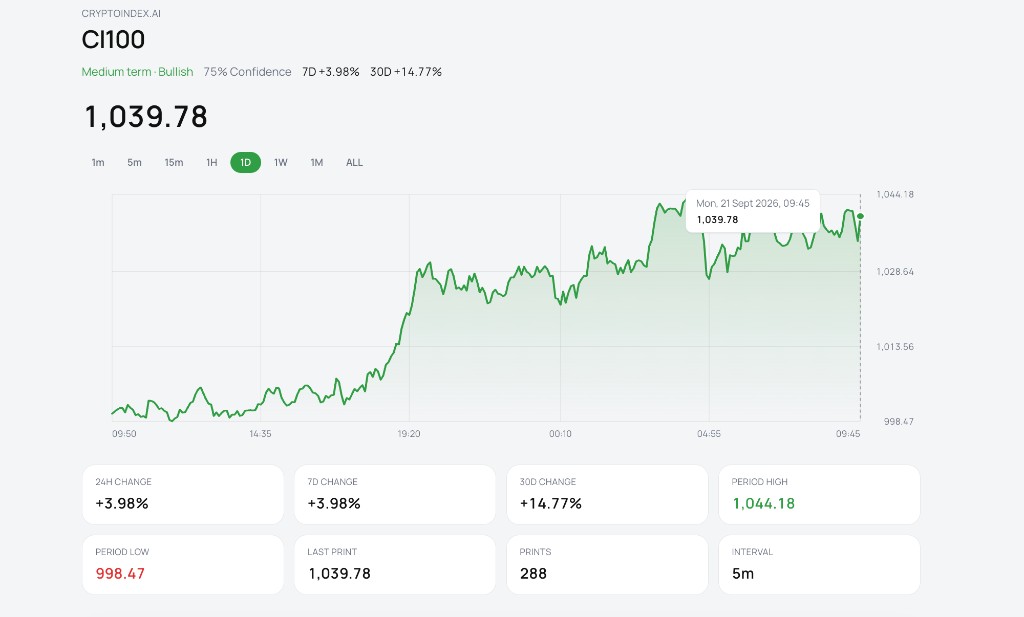
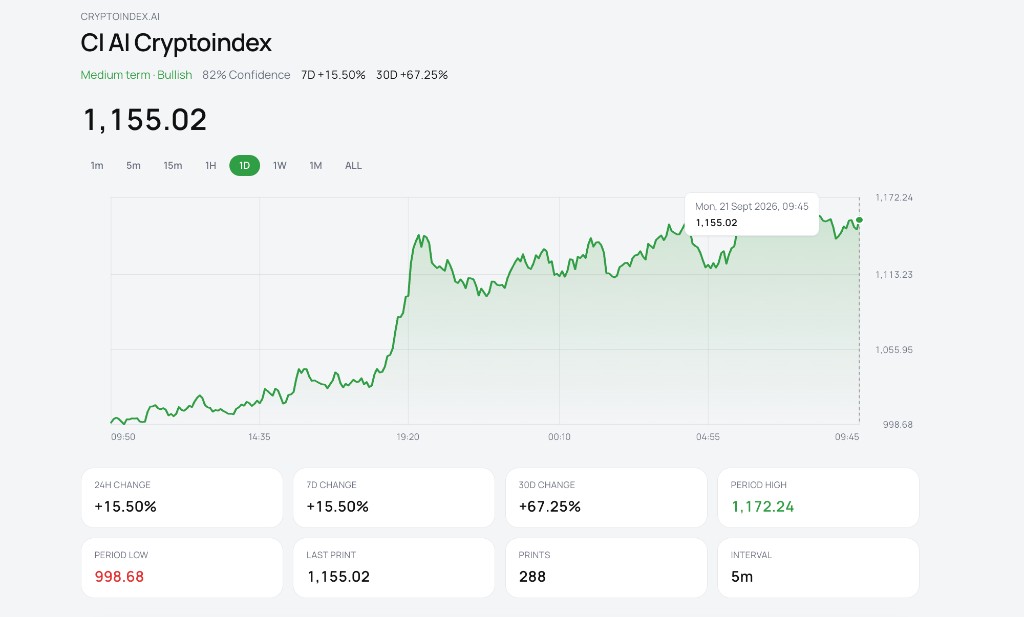
CI100 answers “how did the market move?” CI AI answers “how did this narrative move relative to that market?” When you build in Pro, you usually want both kinds of comparison: your basket vs bitcoin, and your basket vs a broad print like CI100.
Three Starting Points
If you want to build something now and are not sure what:
Your own portfolio. Enter what you actually hold at the weights you actually hold it. Compare against bitcoin and against CI100. Most people find this uncomfortable and informative in roughly equal measure.
A sector you believe in, equal weighted. Pick a boundary, defend it in the thesis, weight everything the same. This tests whether the sector works, rather than whether its largest name works. CI AI is one published version of that idea; yours can draw the line differently.
The same ten assets, three weightings. Build it three times: equal, market cap, and your own conviction weights. Nothing teaches index design faster than watching one basket produce three answers.
The Honest Framing
Cryptoindex Pro is a research tool. It does not execute anything, it does not custody anything, and an index you build there is not a portfolio any more than a spreadsheet is a bank account.
What it does give you is the ability to state a market view precisely enough to be wrong about it. That is a smaller claim than most product pages make and a more useful one.
If you have ever looked at a fund's holdings page and thought "that is not how I would have weighted it," the studio is at cryptoindex.pro/create. If you want to see how the native benchmarks are built before building against them, the formulas are on the methodology page.
Backtests on Cryptoindex Pro represent hypothetical historical performance and do not reflect execution costs. Cryptoindex Pro does not execute trades. Nothing here is investment advice.