Press · Sep 21, 2026
Bitget rToken: How Tokenized Stocks Become Fully Functional Trading Instruments
BitgetrTokenTokenizationEquities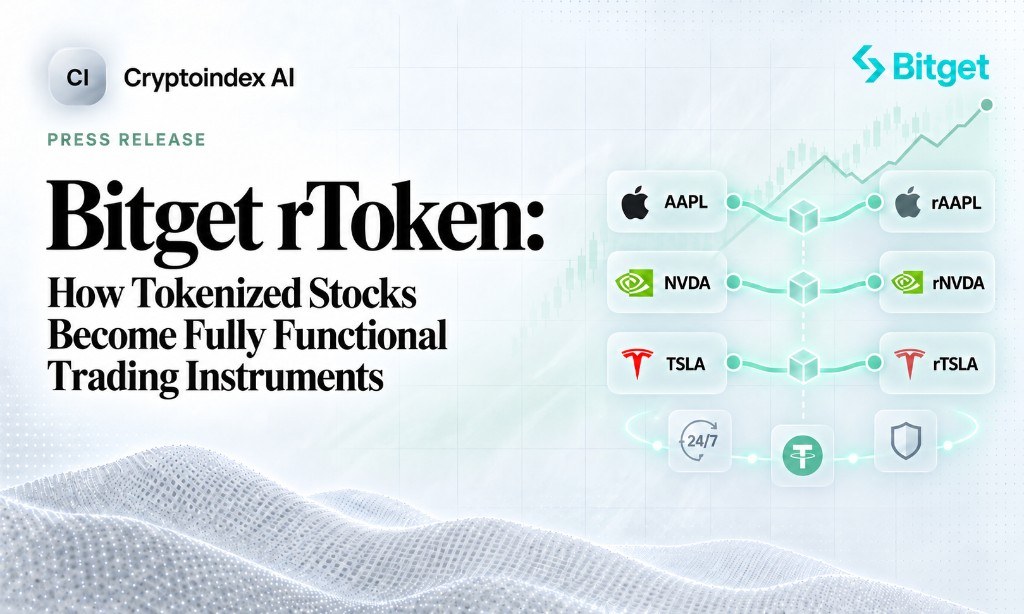
Bitget’s rToken brings 1:1-backed tokenized U.S. stocks and ETFs into a crypto stack — USDT trading 24/7, dividends, and Unified Trading Account collateral.
Tokenization of traditional financial assets is gradually ceasing to be an experiment confined to crypto. In 2026 the market is moving from simply issuing digital replicas of equities toward infrastructure in which tokenized assets can not only be bought and held, but also used across trading strategies.
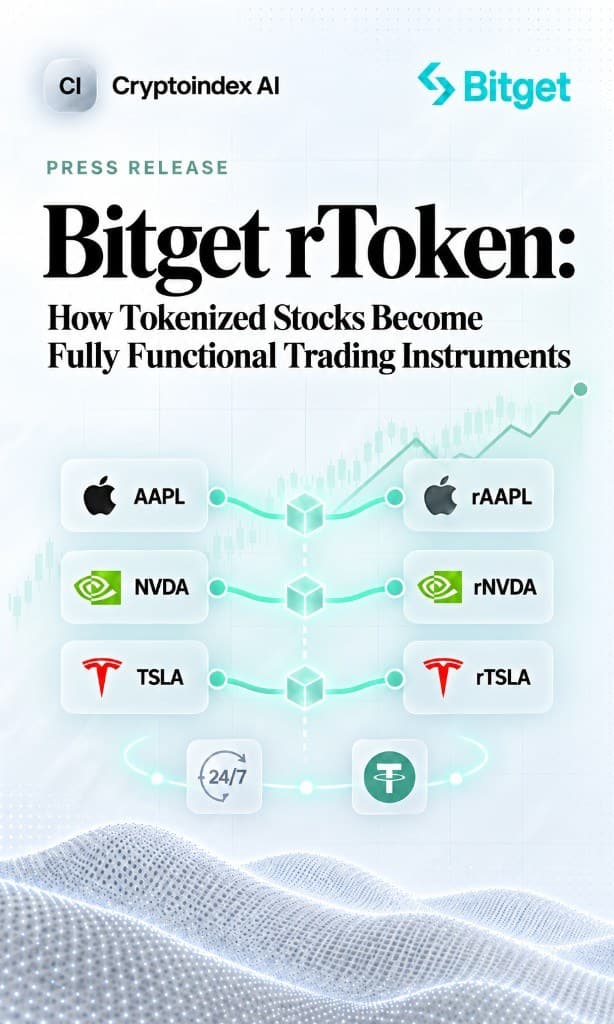
One example of that approach is Bitget’s rToken — a product for trading tokenized U.S. stocks and ETFs. The platform launched on 2 June 2026 as part of Bitget Stocks 2.0. rTokens are issued through the Reality infrastructure and use the underlying ticker with an “r” prefix: rAAPL for Apple, rNVDA for NVIDIA, and rTSLA for Tesla.
The point of rToken is not merely to put a stock price on a blockchain. The emphasis is on turning a tokenized share into an asset that can be used inside a crypto trading stack.
What is an rToken
An rToken is a tokenized asset backed by the corresponding underlying stock or ETF on a 1:1 basis. According to Bitget, the underlying securities are held through U.S. broker Alpaca, which is FINRA-registered and participates in SIPC protection. Reality handles issuance and the tokenized-asset infrastructure, while independent reserve attestation is performed by The Network Firm.
That design detail matters. On the tokenized-equity market, backing is one of the core questions: the digital asset needs a clear link to the underlying security, and users need a way to verify reserves.
Bitget states that reserves are maintained above 100% of issued rToken supply, with reserve attestations published daily. Reality’s infrastructure supports both synchronous and asynchronous minting and redemption depending on the mechanics of a given operation.
How rToken differs from buying a stock the usual way
The main difference is access infrastructure.
Buying a traditional U.S. equity typically means a brokerage account, a fiat funding path, and U.S. market hours.
rToken maps that flow onto a crypto-native model. Users can buy and sell tokenized stocks for USDT directly on Bitget, without a separate brokerage account or bank transfer. rToken trading is available 24/7, though when U.S. cash equities are closed the price anchors to the last available print and liquidity can thin out.
That creates a different user model: a U.S. equity becomes part of a single crypto trading account.
A user can hold BTC, ETH, USDT and rNVDA in one ecosystem, then use part of the tokenized equity as collateral for other activity. In that sense tokenization is not the end product — it is a way to plug a traditional asset into a new financial stack.
The real argument is utility, not tokenization itself
The tokenized-stock market is growing quickly, so issuing a digital replica of a share is no longer a competitive edge on its own.
The sharper question is what a user can do with the tokenized asset after buying it.
For rToken, the answer has several layers.
First, the asset can be traded against USDT.
Second, supported rTokens can be used as margin collateral inside the Unified Trading Account. Users do not have to sell the tokenized stock to free capital for another strategy.
Third, rTokens connect to other Bitget tools — including API access, automated strategies, Smart Portfolio, Crypto Loans and selected structured products.
A tokenized share stops being a passive buy-and-hold wrapper and becomes part of a capital-management system.
That functional depth is one of the most interesting parts of the rToken model.
Dividends and corporate actions
Another key question for tokenized equities is how fully the digital instrument mirrors the economics of the underlying.
Bitget states that holders of the relevant rTokens receive dividends on the underlying shares. Payouts are made in USDT and credited automatically to the user’s spot account. Reality’s infrastructure also supports corporate actions, including stock splits and reverse splits.
That sets rToken apart from many early tokenized-asset models that offered price exposure alone, without the fuller economic package of a traditional share.
Specific rights and product availability still depend on jurisdiction and the terms of each instrument.
Scaling: from hundreds of millions to billions
rToken’s early numbers suggest interest in tokenized equities is moving beyond experimental use.
In the first five weeks after launch, assets under management for rToken topped $100 million, reaching about $114 million by 6 July. Over the same period cumulative trading volume reached $671.37 million, and users exceeded 100,000.
Activity then accelerated. From 2 June to 19 July cumulative spot volume in rToken reached $1.16 billion. Average daily volume was about $17.9 million in June and rose to $33.8 million from 1–19 July.
Transaction counts are even more telling. By 5 August Reality reported more than 2 million cumulative transactions, and July rToken trading volume rose 121.95% versus June. On one day, operations reached 127,691.
For tokenized equities that matters more than AUM alone. High assets under management can show interest; turnover, trade frequency and market depth show whether the tokenized asset is actually being used as a trading instrument.
Liquidity becomes the main competitive edge
Early on, the market’s main question was whether tokenized stocks existed. The question is shifting: how effectively can they be traded?
That matters especially for larger participants. Wide spreads and thin books erode the edge versus a traditional brokerage venue.
According to Bitget, average daily rToken volume rose from $17.9 million in June to $33.8 million in the first half of July, while institutional user volume over the stated period reached $56.4 million.
Further progress for rToken will depend not only on listing more names, but on sustaining enough liquidity as order sizes grow.
From a few popular names to a broader market
Interest in tokenized equities naturally concentrates first around household names — NVIDIA, Apple, Tesla, Microsoft, Amazon and other large issuers.
Scaling further requires broader market coverage.
In September Bitget Wallet integrated Reality, unlocking access to more than 1,700 tokenized stocks and ETFs. Bitget says that set covers about 95% of total U.S. equity trading volume. The integration also pushes the rToken model beyond the centralized exchange — tokenized assets become available through Bitget Wallet’s self-custody stack.
That is an important step: tokenization starts to look less like a single exchange product and more like an infrastructure layer usable across interfaces and workflows.
rToken and the Universal Exchange model
rToken fits a broader Universal Exchange idea — bringing crypto, traditional instruments and onchain assets into one trading infrastructure.
In the traditional setup a user jumps between platforms: a crypto venue for digital assets, a broker for stocks, a separate app for ETFs, and other tools for capital management.
The rToken model treats tokenized equities as another asset class inside one trading space.
That is especially relevant for crypto users already used to 24/7 trading, USDT settlement, margin collateral and programmable strategies. For them a tokenized stock is not just a digital copy of a traditional instrument — it is an asset compatible with crypto infrastructure.
The model still has limits
The advantages of tokenization do not erase the constraints.
First, 24/7 trading does not mean constant liquidity. When U.S. exchanges are closed, the underlying market is not forming a new continuous price in the usual way, so spreads and depth can change.
Second, tokenized-equity infrastructure depends on several components at once — the issuer or token provider, custodian, broker, oracles, blockchain and trading venue. Product reliability is not defined by blockchain technology alone.
Third, the regulatory landscape is still evolving. In September 2026 the SEC announced a five-year conditional exemption for certain venues trading tokenized stocks, while stressing the need to preserve standard shareholder rights, including dividends and voting. New rules open room for market growth and raise the bar for what counts as a fully fledged tokenized security.
That distinction matters as the market splits between models truly linked to underlying securities and products that only track price.
What will shape the next stage
Several factors will shape rToken and the wider tokenized-equity market.
First — liquidity. Deeper books and higher volumes bring tokenized stocks closer to a real alternative trading infrastructure.
Second — capital efficiency. Using equities as collateral and combining them with derivatives and other instruments may matter more than tokenization itself.
Third — reserve transparency. Investors need to know issued tokens are backed by underlying assets and how often that is attested.
Fourth — regulatory clarity. Clearer rights for holders of tokenized equities make institutional capital easier to attract.
Fifth — onchain integration. Connecting rTokens to wallets, DeFi and other blockchain protocols can expand use cases.
Bottom line
The distinctive feature of rToken is that Bitget is trying to solve not only access to U.S. equities, but what happens after access.
Buying a stock with USDT, trading 24/7, fractional positions, dividends, reserve attestation and the ability to use supported rTokens as collateral tie a traditional financial asset into crypto-market infrastructure.
Against that backdrop, the real success metric is no longer how many tokenized names exist, but how actively they are used in live trading strategies. Rising volumes, transaction counts and user numbers suggest the market is moving that way.
If the trend holds, tokenized equities may stop being seen as a separate RWA niche. They may become a core piece of a financial stack where crypto, stocks, ETFs and other assets share one capital and trading space.
That is why rToken is interesting not merely as a way to tokenize stocks, but as an attempt to make traditional financial assets full participants in the crypto economy.