Index Methodology
Crypto Index Rebalancing Explained
Index Methodology · Sep 29, 2026
Index Methodology
Monthly catches rotation faster. Quarterly costs less in turnover. Neither is universally better — here is what the calendar actually changes.
What rebalancing does
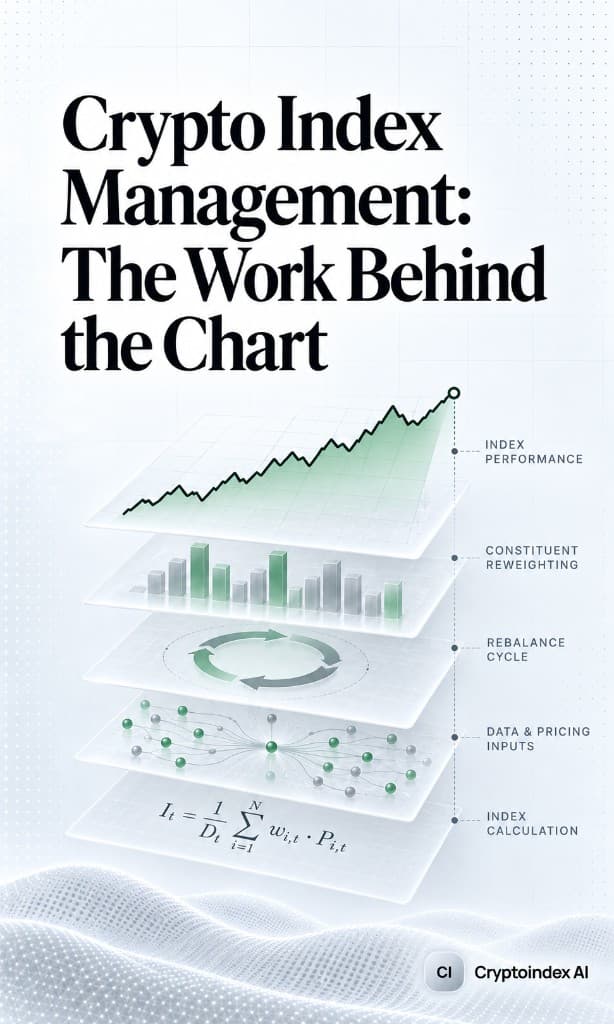
An index rulebook picks a universe, a weighting scheme and a calendar. On each reconstitution date the administrator:
- Re-ranks eligible assets
- Applies caps, buffers and exclusion screens
- Publishes the new target weights
- Adjusts the divisor so the index level does not jump on housekeeping alone
Funds and ETPs that track the index then trade toward those targets. Display-only series on this site follow the same logic without an investable wrapper.
Monthly vs quarterly
Monthly (Bitwise 10 / BITW) catches rotation faster. A coin that breaks into the top ten in week two of a month can sit in the basket within weeks, not a full quarter. The cost is higher turnover: more sells of leavers, more buys of joiners, more chance that reconstitutions land in thin liquidity.
Quarterly (CoinDesk family / GDLC) is calmer. Fewer trades, a simpler story for investors, and more lag when the market’s large-cap set is shifting quickly.
Neither is “correct.” Monthly fits investors who want the live ranking. Quarterly fits investors who want lower reconstitution noise. For how that interacts with fees and spreads, see tracking error and NAV.
Buffers and turnover
Serious methodologies use buffers so a coin does not flip in and out every period on a tiny market-cap difference. A typical pattern: a new entrant must rank clearly inside the cut-off, and a current member must fall clearly outside, before the membership changes. Buffers cut turnover. They also mean the published “top N” is not a raw screenshot of CoinMarketCap on review day.
What rebalancing costs you inside a fund
Even if you never trade, the fund does. Turnover shows up as:
- Bid-ask paid by the vehicle
- Market impact on less liquid names
- Taxable events inside some wrappers (jurisdiction-dependent)
- Tracking difference versus a paper index that assumes frictionless fills
A cheap expense ratio with frantic monthly turnover can still lose to a slightly dearer product that reconstitutes less often — depending on the year.
DIY rebalancing
If you hold the basket yourself, you are the rebalancing agent. Missing a scheduled rebalance is how DIY portfolios quietly become concentrated winners. Writing the rule down — dates, thresholds, maximum trades — matters more than picking the “perfect” frequency. See index fund vs buying coins.
Frequently asked questions
Does more frequent rebalancing improve returns?
Not reliably. It improves fidelity to the live rulebook. Whether that helps or hurts depends on the market regime and on costs.
Why do some indices rebalance and reconstitute on different dates?
Membership changes (reconstitution) and weight resets (rebalancing) can be separate events. Read the methodology; the labels are not standardised across providers.
Where do BITW and GDLC sit?
BITW follows a monthly Bitwise schedule. GDLC follows CoinDesk’s quarterly family schedule. Details: BITW vs GDLC.
Cryptoindex.ai publishes index data and market analysis for informational purposes. This is not investment advice. Digital assets are volatile and you can lose your entire investment.