Markets · Sep 27, 2026
How Prediction Markets Work and How Traders Make Money on Them
Prediction Markets
A share that pays $1 or nothing is just a probability with a price. How the mechanics work, why most Polymarket wallets lose, and how Pulse Market helps you find an edge.
A prediction market lets you buy shares in the outcome of an event. Each share pays $1 if the outcome happens and nothing if it doesn't, so its price in cents is the market's estimate of the probability. Traders make money in two ways: by buying an outcome for less than its real chance and holding it to settlement, or by buying before the price moves and selling after. Neither is guaranteed, and on Polymarket most wallets lose. This guide explains the mechanics, where the money actually comes from, and how Pulse Market helps you find events and check whether you have an edge.
How a prediction market works
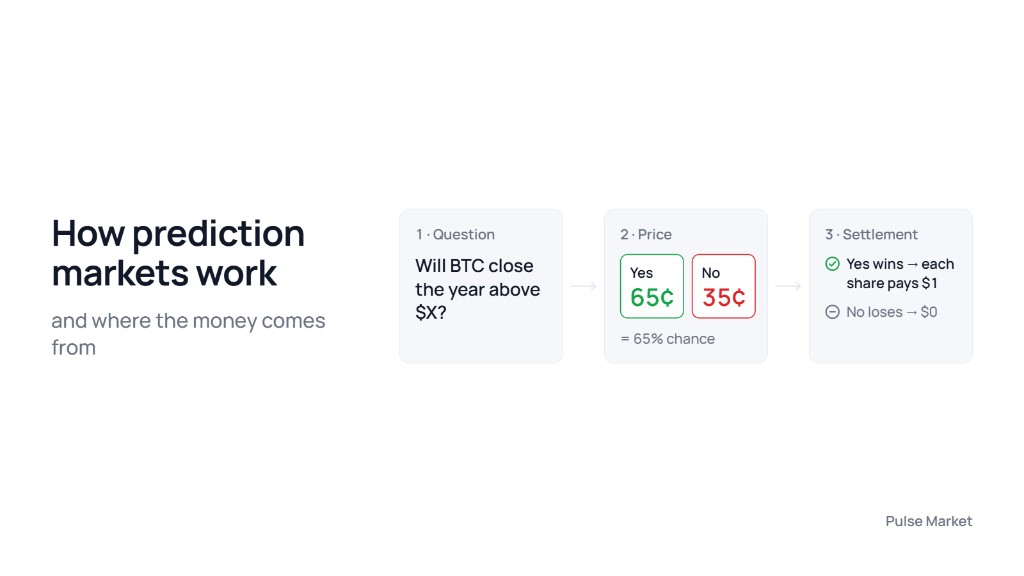
Take a question: will bitcoin close the year above a given level? The market has two sides, Yes and No, and together they always add to $1. If Yes trades at 65¢, No trades at 35¢. The market is saying: roughly a 65% chance.
Buy $10 of Yes at 65¢ and you get about 15 shares. If bitcoin closes above the level, each share pays $1 and you receive about $15. If it doesn't, the shares are worth nothing and you've lost $10. That's the whole payout structure. Everything else is about the price.
There's no bookmaker setting odds and no margin built into the line. You trade against other people who took the opposite side, and the price sits wherever buyers and sellers agree. News moves it through their trades: a poll, a goal, a central bank statement, a sharp move in bitcoin dominance.
Two more details matter from day one. First, markets settle by the exact wording of the question, not its spirit, so "above $100,000" and "touched $100,000" are different bets. Second, you don't have to wait for settlement. While a market trades, you can sell your shares at the current price.
Where the money actually comes from
Every dollar a winner collects comes from someone on the other side. So "how do I make money" really means "where am I right and the price wrong". There are two ways to be right.
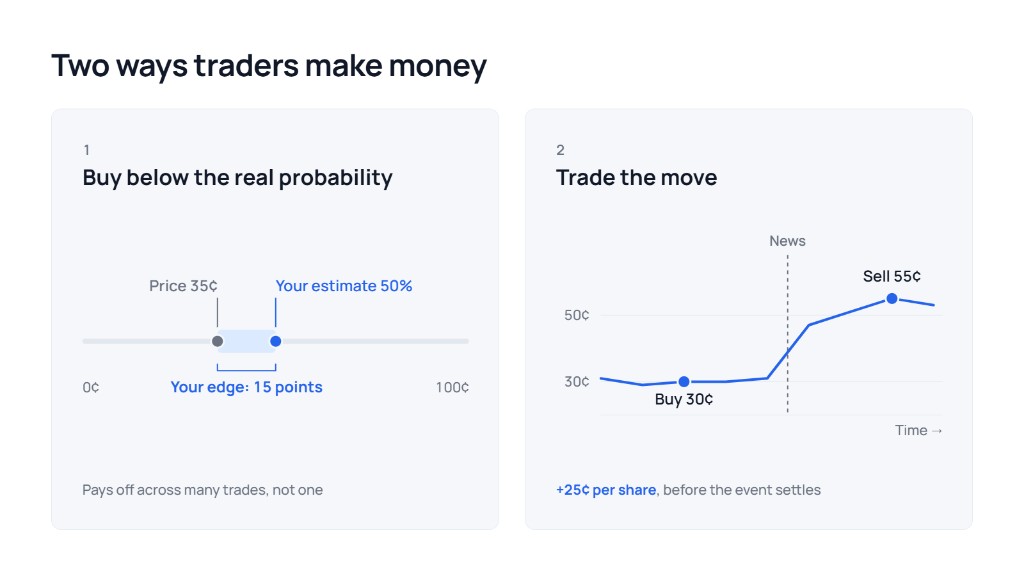
Buy below the real probability. You think an outcome has a 50% chance and it trades at 35¢. If you're right about the 50%, then across many trades like this you collect $1 about half the time while paying 35¢ every time. That gap is your edge. One trade proves nothing, because a 50% outcome still fails half the time. The edge shows up only across many trades.
Trade the move. You buy at 30¢, news breaks your way, the price goes to 55¢, and you sell. You made 25¢ a share without waiting to see what happens. The profit came from the market changing its mind, not from the outcome.
Both depend on the same skill: estimating probability better than the price does, and doing it before the market catches up.
Why most traders lose
It's worth being blunt about this. An on-chain analysis of 2.5 million Polymarket wallets, published by researcher Andrey Sergeenkov in April 2026, found 84.1% of them in the red. Only about 2% had made more than $1,000.
The reasons are mostly mechanical, not mysterious:
- Paying for certainty. Buying favourites at 92¢ feels safe, but it pays 8¢ when you're right and costs 92¢ when you're wrong. A few surprises wipe out many small wins.
- Ignoring the spread. The gap between the best buy and sell price is paid on the way in and again on the way out. On a 50¢ share, a 3¢ spread costs 6% at entry.
- Trading every headline. By the time news reaches most people, the price has usually moved.
- Never checking results. Most traders remember their good calls and forget the rest, so they never find out whether they're calibrated.
The rest of this guide is about avoiding those four.
Finding events worth trading
Polymarket lists more than ten thousand events across politics, sport, crypto, economics, culture and more. The hard part isn't access, it's attention: finding the few markets where your view differs from the price.
Pulse Market's screener puts every tradable market into one table with five presets:
| Preset | What it shows | Why it's useful |
|---|---|---|
| All markets | Everything tradable, sorted by 24-hour volume | Where the money and attention are |
| No clear favourite | Both sides between 40¢ and 60¢ | The market is least sure, so a good read is worth most |
| Top movers | Price moved more than a tenth within the hour | News is being priced right now |
| Live now | Matches that started in the last eight hours | In-play sport |
| Closing soon | Resolving within 24 hours | Little time left for the price to drift |
Every column filters by range: price, hourly and daily change, liquidity, volume, spread, time to close. Time to close is easy to overlook: a 10-point gap that resolves tomorrow earns far more per dollar per month than the same gap resolving in six months.
For crypto questions, market structure is the best input you have. On Cryptoindex.ai, read bitcoin dominance with and without stablecoins and the altcoin season index. Then in Pulse, filter by the Crypto topic, set time to close to weeks rather than minutes, and sort by liquidity. Now you're looking at questions about levels and outperformance with a view already formed, and with the spread of each market visible before you open it.
Making the trade on Pulse Market
Pulse Market is a terminal for Polymarket. It doesn't create markets: events, prices and liquidity come from Polymarket, orders execute in Polymarket's book, and settlement runs on Polygon. Pulse is a verified Polymarket builder. What it adds is the path in and the tools around the trade.
Getting in. Sign in with a six-digit code sent to your email, or with Google. There's no password and no seed phrase to write down. The terminal creates a wallet for you. Keys are stored encrypted, and if you registered by email you can export the private key. Before the first deposit you activate the trading account with two signatures.
Funding. Deposit USDC or USDT on BSC, Polygon, Ethereum, Base, Arbitrum or Optimism, from $10. The terminal converts it into your trading balance and shows the conversion fee and timing before you send. Withdrawals go back the same way.
Placing the order. The trade panel shows the average price, the number of shares and the total, fee included, before you confirm. A market order fills at once from the book, from $1. A limit order, currently in beta, rests at your price until it fills, you cancel it or it expires. The Liquidity block under the panel shows the book and the spread, so you see what the trade will cost before it costs you.
Exiting. Sell any time before settlement, in full or in part. When a market resolves, claim winning shares with one button. You don't pay network fees for trades, claims or activation.
Checking whether you actually make money
This is where most traders are flying blind, and where Pulse is most different from a plain exchange interface.
The Price vs. win block in Analytics compares your entry prices with how often those trades actually won. Say you bought twenty outcomes at around 30¢. At those prices, about six should win. If nine won, you've been buying below the real probability: that's an edge, measured. If two won, the market read those prices better than you did, and it's cheaper to learn that after twenty $1 trades than after twenty $100 ones.
Around it sits the rest: profit by day, week and month, win rate, average stake, best and worst trade, results by category, win streaks, and two behavioural readings that tend to sting. Time held, split between winners and losers, shows whether you sit in losing positions longer than winning ones. The profitable side shows whether Yes or No pays you, and a strong tilt is usually a habit rather than an insight.
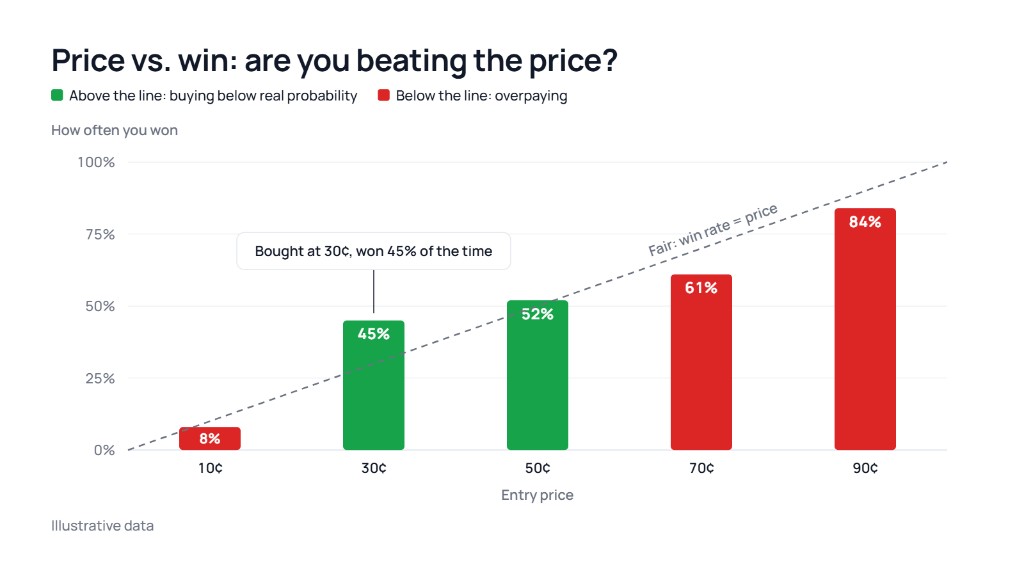
Ten trades tell you about luck. A few dozen start telling you about skill.
What it costs
Each trade carries a trading fee, shown inside the total before you confirm. Deposits and withdrawals carry a conversion fee, shown before you send. Network fees for trades, claims and activation are covered. The screener and analytics are free to use.
Limits worth knowing
- One venue. Pulse trades Polymarket markets only. If an event isn't listed there, it isn't in the terminal.
- No sign-in with your own wallet. Sign-in is by email or Google. You can export the key the terminal creates, but you can't connect an existing wallet.
- Limit orders are in beta. Treat fills on thin books with care.
- Access depends on where you are. Polymarket's terms apply to every interface built on it.
- Not built yet. Rule-based automation, an AI assistant for market and trade review and API access for your own bots are announced, not live.
Your first trade
Open the Pulse Market terminal and pick the No clear favourite preset. Choose one market you can explain in a sentence. Before you look at the price, write down your own probability. Then compare: if your number and the price differ by more than the spread, buy $1. After the market settles, come back to your note and check it against the result. Do that twenty times, then open Price vs. win.
For more depth, Pulse's blog covers reading a price as a probability, crypto markets on Polymarket from five-minute sessions to year-end levels, and what the 84% of losing wallets can and can't teach you.