Index Methodology
Crypto Index Management: The Work Behind the Chart
 Roman Wiligut· Analyst and AI Researcher
Index Methodology · Sep 10, 2026
Index Methodology
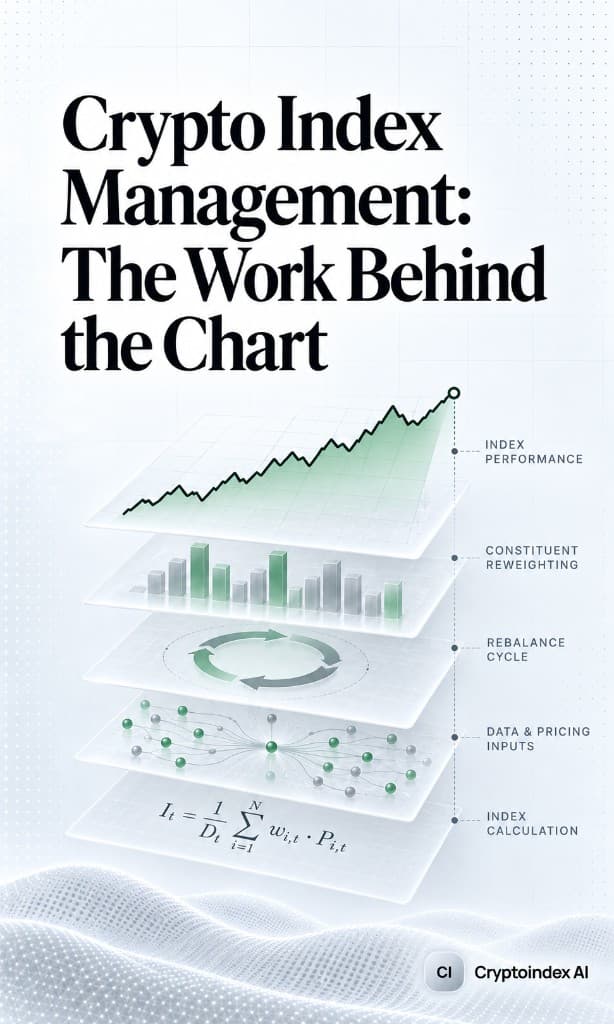
A fork, an airdrop, a dead venue. Index management is the set of decisions that produce the chart - and the difference between a benchmark and a number on a website.
In August 2017, bitcoin split in two. Anyone holding BTC woke up holding BTC and Bitcoin Cash. For an individual that was a windfall and a mild inconvenience. For anyone running a bitcoin index it was a decision that had to already have been made, in writing, before the fork happened.
Does the new chain count as a constituent? At what price, when it has no trading history? Does its value get distributed to the index level, or dropped? If the index says nothing, whatever the code does becomes the policy by accident.
That is index management. It is not the chart. It is the set of decisions and daily operations that produce the chart, and it is where the difference between a serious benchmark and a number on a website actually lives.
Two Different Things Share the Name
Worth separating before going further, because "crypto index management" gets used for both and they are different jobs.
Index administration. Running the index itself: maintaining the rules, sourcing prices, deciding what happens during unusual events, executing reconstitution, governing changes. The output is a number.
Portfolio management against an index. Running a fund that tracks the index: buying the constituents, rebalancing when the index does, minimising the gap between fund and benchmark. The output is a portfolio.
The first one determines what the target is. The second one tries to hit it. Most articles about indexing describe neither and go straight to performance charts.
What Index Administration Actually Involves
Strip away the marketing and the job is about seven recurring tasks.
Universe maintenance. Deciding which assets are even eligible for consideration. This runs continuously, not just at reconstitution, because the criteria involve things that change: custody support, exchange availability, exploit history, whether an asset might be deemed a security.
Price sourcing. Selecting venues, weighting them, and defining how outliers get excluded. This is the least glamorous and most consequential part of the whole operation. An index is only as good as the prices going into it.
Calculation and publication. At defined intervals, from defined inputs. The CoinDesk 20 publishes every five seconds. That cadence is an operational commitment, not a feature.
Corporate action handling. Except crypto has no corporate actions, so it has the crypto equivalents instead: forks, airdrops, token migrations, rebrands, supply schedule changes, staking rewards. More on these below, because they are the part with no traditional-finance playbook.
Reconstitution. Executing the periodic rebalance. The CoinDesk 20 does this quarterly at 4 p.m. Eastern on the effective date. The Bitwise 10 index does it monthly on the last business day, with a record date one week prior and a possible intraday rebalance if a specific weight condition breaks during the day.
Contingency. What happens when an input disappears. An exchange goes offline, an API fails, a chain halts. Nasdaq publishes contingency measures for exactly this, and the existence of those procedures is part of what you are paying for with a licensed benchmark.
Governance. Someone has to approve rule changes and document why. The Nasdaq Crypto Index has an oversight committee that must approve any material methodology change, reviews the methodology at least annually, and reviews each constituent at least once in any twelve-month period.
None of that appears on a chart. All of it determines whether the chart means anything.
The bottom row is the point of that diagram. Scheduled work is easy to describe and easy to automate. The unscheduled events are what separate a managed index from a script.
The Crypto-Specific Problems
Equity index administrators have a hundred years of precedent for stock splits, dividends, mergers and spin-offs. Crypto index administrators have a decade and a much stranger set of events.
Forks. When a chain splits, an index holding the original has to decide whether the new asset is a constituent, how to price it before it has meaningful trading history, and whether its value flows into the index level. The 2016 Ethereum split and the 2017 Bitcoin Cash fork forced every index in existence at the time to answer this, and they did not all answer it the same way.
Airdrops. Free tokens distributed to holders. Does the index recognise value it did not buy? If yes, at what price, given that airdropped tokens often have no liquid market for days. If no, the index is understating what a holder actually received.
Token migrations. A project moves from one chain or contract to another. Same asset, new ticker, new address, sometimes a new supply. The index has to treat this as continuity rather than a deletion plus an addition, or the history breaks.
Supply changes. Free-float weighting depends on circulating supply. Crypto supply changes on unlock schedules, burns and emissions, sometimes materially and sometimes with little notice. The Nasdaq methodology handles this by fixing supply at reconstitution and letting only price move in between, which is a clean answer with a known trade-off: weights drift from reality between rebalances.
Staking. If an asset earns staking rewards, does the index include them? A price-only index says no. A total-return index says yes. Both exist, they diverge substantially over time, and the difference is easy to miss when comparing two indexes that look otherwise similar.
Venue failure. An exchange in the pricing set collapses. FTX was the obvious case. An administrator needs a documented procedure for removing a venue mid-calculation without breaking the series.
No market close. Crypto trades continuously. There is no closing auction, no official daily print that everyone agrees on. Every index has to invent its own definition of "the end of the day," and different indexes pick different moments.
That last one is a good example of how much of this work is invention rather than adaptation. Equity indexing inherited a market structure with a close built into it. Crypto indexing has to define one.
Who Actually Does It
Three arrangements exist in crypto, and knowing which one you are looking at is useful.
Independent administrator, separate calculation agent. The Nasdaq Crypto Index is owned and administered by Nasdaq with CF Benchmarks as calculation agent, and the index rules can only be changed by the provider with committee approval. The sponsor of any fund tracking it has no control over the rules.
Provider-affiliated administration. The index is administered by an entity related to the firm running the tracking product. The Bitwise 10 Large Cap Crypto Index is administered by Bitwise Index Services, and the corresponding ETF is a Bitwise product.
Self-published display index. A site defines and publishes its own series with no fund attached. Our own CI100 falls here, and so do most of the index numbers you see on aggregators.
None of these is illegitimate, and the second is common in traditional finance too. But the incentive structures differ, and a provider-affiliated arrangement puts more weight on the published governance process, because there is no organisational separation doing that work for you.
Benchmark Regulation Is Why the Structure Exists
The reason licensed indexes publish oversight committees and contingency procedures is not corporate habit. After the LIBOR manipulation cases, benchmark administration became a regulated activity in several jurisdictions. The EU Benchmarks Regulation and the IOSCO principles set requirements on governance, conflicts of interest, input data quality, methodology transparency and how changes get made.
Those requirements are the reason "index management" is a job title rather than a cron job.
The Other Half: Managing a Portfolio Against an Index
Briefly, because it is the side that affects your returns directly.
A fund tracking an index has to hold what the index holds, in the proportions the index specifies, and change when the index changes. The gap between the fund and the benchmark is tracking difference, and it comes from four places:
- Execution cost at every rebalance, in assets that are frequently thin
- Timing differences between when the index rebalances and when the fund actually trades
- Cash drag from unhedged flows
- Custody and operational constraints that occasionally prevent holding a constituent at all
That last one is not theoretical. The Hashdex ETF referencing the Nasdaq Crypto US Settlement Price Index was initially limited to holding only bitcoin and ether, even though the index itself contained more assets. It expanded to bitcoin, ether, Solana, Stellar and XRP once listing standards permitted, with Cardano added from 30 September 2025. For a period, the fund and its benchmark held different things, and the reason was regulatory rather than financial.
What to Check Before Trusting Any Index
Six questions. All answerable from public documents, none requiring a terminal.
- Who administers it, and are they affiliated with any fund tracking it?
- What are the price sources, and what happens when one fails? If contingency procedures are not published, there are probably not any.
- How are forks, airdrops and migrations handled? This is the single best test of whether a methodology was written by someone who has done this before.
- Is it price-only or total-return? Staking treatment alone can account for a large divergence over years.
- When was the methodology last changed, and who approved it?
- What is the reconstitution schedule, and is there an unscheduled trigger?
An index that answers all six clearly has been managed. An index that answers none has been calculated.
The difference does not show up on a chart, which is exactly why it is worth checking before you rely on one.
Methodology and governance notes for the major benchmarks are on our analysis pages.
Frequently asked questions
What is crypto index management? The work that produces the chart: universe rules, price sourcing, calculation, forks and other crypto events, reconstitution, contingency procedures and governance. It is not portfolio management against the index.
Who administers a crypto index? An independent administrator with a separate calculation agent, a provider affiliated with a tracking product, or the site that publishes a display series. CI100 is the third kind. None is illegitimate; the incentive structures differ.
How do crypto indexes handle forks? They recognise the new chain at the first traded price, wait for a stabilisation window, or ignore it. Serious methodologies pick one of those answers in writing before the fork happens.
What should I check before trusting an index? Who administers it, the price sources and contingency rules, fork and airdrop treatment, price-only versus total-return, who last changed the methodology, and the reconstitution schedule.
Cryptoindex.ai publishes index data and analysis for informational purposes and is not affiliated with any index administrator or fund issuer named here. Nothing on this page is investment advice.