Structure
The Word ETF Is Doing a Lot of Work in Crypto ETF
Funds · Sep 23, 2026
FundsETFETPStructure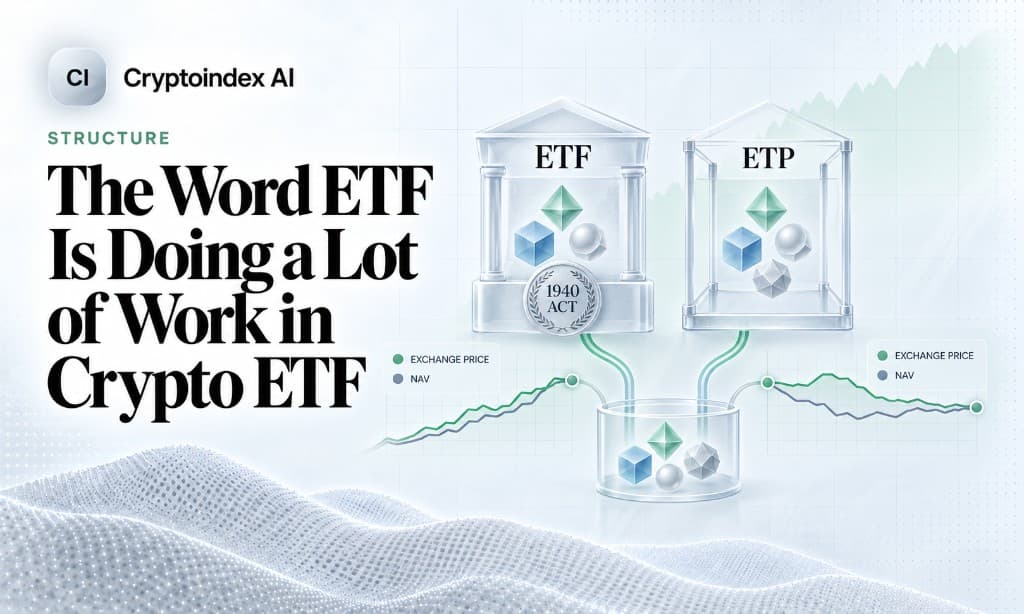

Grayscale puts it in bold on every GDLC page: not a 1940 Act ETF. Most coverage skips that line. It is the most consequential fact about US crypto basket products.
Open Grayscale's page for GDLC and the disclaimer starts before the marketing does. The fund, it says, is not registered under the Investment Company Act of 1940 and therefore is not subject to the same regulations and protections as 1940 Act registered ETFs and mutual funds.
Grayscale puts that at the top, in bold, on every page. They are not hiding it. Almost every article written about the fund leaves it out anyway, because it is a legal detail and legal details do not get clicks.
It is also the single most consequential fact about the product, and it applies to basically every crypto basket product on a US exchange.
Two Things Called ETF
When someone says ETF, they usually picture a specific legal object: a fund registered under the Investment Company Act of 1940, subject to its diversification rules, its custody requirements, its board governance, its limits on leverage and affiliated transactions. That framework is why an equity index ETF feels like plumbing rather than a product.
Crypto basket funds on US exchanges are generally not that. They are exchange-traded products: trusts that hold assets and issue shares, listed on an exchange, trading like a stock, and sitting outside the '40 Act framework entirely.
The user experience is nearly identical. You buy it in a brokerage account with a ticker. It has a NAV, a fee, a holdings page, an authorized participant mechanism for creations and redemptions.
The legal experience is not identical, and the difference shows up exactly when you would want protections most.
What You Do and Do Not Get
You do get the things that matter most day to day. Exchange listing and continuous pricing. A creation and redemption mechanism that keeps the share price close to the value of the holdings. Institutional custody, in GDLC's case with Coinbase Custody Trust Company, and an administrator, BNY. SEC-reviewed registration statements and ongoing filings, which is why the holdings data in this article comes from public documents rather than from a press release.
You do not get the '40 Act's structural requirements. No mandated diversification limits. No fund board with the independence requirements a registered fund carries. Not the same restrictions on affiliated transactions. Not the same regulatory recourse if something goes wrong at the sponsor level.
None of this makes the products unsafe. It makes them a different legal animal from the one most people picture, governed by trust documents and securities law rather than by the '40 Act's specific framework.
Why It Exists This Way
Not an oversight. A consequence.
The '40 Act was written for funds holding securities, with custody rules built around securities custodians and valuation rules built around securities markets. Crypto assets do not fit those categories cleanly, and a decade of attempts to force the fit is a large part of why US crypto funds took as long as they did to arrive.
The trust structure was the available route. It let sponsors create something that trades on an exchange and holds crypto directly, without first resolving every question about how the '40 Act applies to an asset class it never contemplated.
So the structure is the price of the product existing. That is a defensible trade, and it is still a trade.
Where It Actually Bit People
The discount story is the concrete version of this, and it is recent enough that plenty of investors lived it.
Before conversion, several of these vehicles traded over the counter with no efficient creation and redemption mechanism. Without that mechanism, nothing forces the share price back toward the value of the underlying holdings. GDLC's predecessor and BITW both spent long stretches at wide discounts to net asset value.
If you needed to sell during one of those stretches, you took the discount as a real loss, on top of the fee and on top of whatever the market had done. That was not a market risk you chose. It was a structural feature of the wrapper.
Conversion to exchange-traded status largely fixed it, because arbitrage through creations and redemptions is the whole point of the structure. As of 8 September 2026, GDLC's NAV was $36.06 against a market price of $36.03, a discount of under a tenth of a percent. That is the mechanism working.
The risk is reduced rather than eliminated. Discounts can still open during stress, when creation and redemption becomes harder precisely when you want it to work smoothly.
The Other Thing Hiding in the Dates
While reading filings, check the dates. GDLC's are instructive:
| Fund inception | 1 February 2018 |
| Public quotation | 22 November 2019 |
| ETP listing | 19 September 2025 |
An eight-year-old vehicle in a one-year-old wrapper.
That pattern repeats across the space. BITW launched as a private index fund in November 2017, became a Delaware statutory trust in 2020, traded over the counter for years, and listed on NYSE Arca on 9 December 2025.
Why it matters: when you look at a long performance chart for either fund, a large part of it describes the vehicle operating under completely different conditions, with different liquidity, different pricing dynamics and, in the discount years, different economics for anyone who had to exit. The ticker is continuous. What it represented is not.
What to Actually Check
Five things, all in public documents, all findable in a few minutes.
Is it a '40 Act ETF or an exchange-traded product? The prospectus says so plainly, usually on the first page. This is the question, not a footnote to it.
Who is the custodian, and what does the custody arrangement say? In a structure without '40 Act custody rules, the specific arrangement is what you are relying on.
What is the creation and redemption mechanism? Cash or in-kind, and through which authorized participants. This determines whether the arbitrage that keeps price near NAV actually functions.
What does the premium and discount history look like? Not the current reading. The worst readings, and when they happened.
When did the current structure begin? Everything before that date on the chart describes a different product.
The General Version
This is not really about crypto. It is about a pattern that shows up wherever a familiar word gets attached to an unfamiliar legal object because the familiar word sells better.
The word ETF carries decades of accumulated trust that was earned by a specific regulatory framework. When it gets applied to something outside that framework, the trust comes along for free and the framework does not.
Issuers here are largely being straight about it. Grayscale's disclaimer is at the top of the page in bold, not buried in an appendix. The gap is in the coverage, not the disclosure, and it is a gap you can close yourself with one search of the prospectus.
Read what the issuer says about its own structure before reading what anybody else says about its performance.
Full breakdowns of both US multi-asset products are in best crypto index funds.
Structural and fund data from issuer materials and SEC filings as of September 2026. Cryptoindex.ai is not affiliated with Grayscale or Bitwise and receives no compensation from any fund issuer. Nothing here is investment advice.